

 Explore Worlds
 Find Life
 Defend Earth


The Planetary Report • June solstice 2012
Dark Skies?
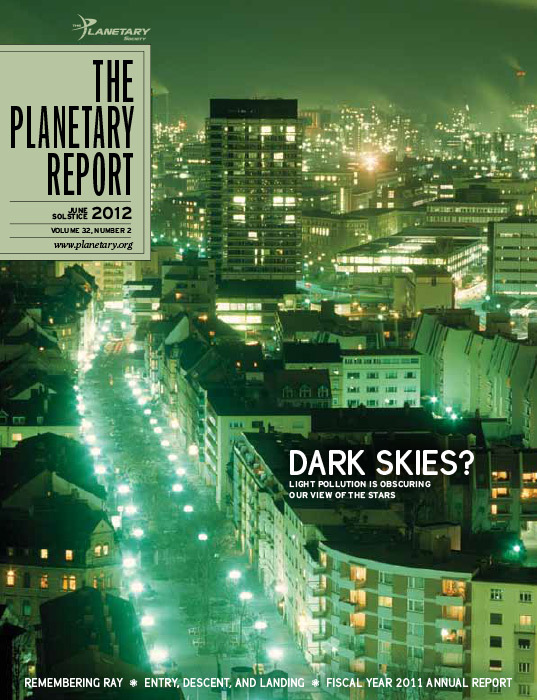
On the Cover: A love affair with space exploration began early in life for many of us, when we first gazed at a sparkling night sky and wondered what kinds of worlds might fill the universe. Many Earthlings—denizens of cities and densely populated areas—have never seen a truly clear sky, however. Excess, unshielded light at night creates light pollution. Not only do runaway photons cloud our view of the heavens, but they also can disrupt ecosystems and the well-being of animals such as birds, reptiles, and humans.
Features
6 In Memoriam: Louis Friedman reflects on the death of a longtime friend.
7 Into the Dark: W. Scott Kardel hopes for a darker sky.
14 Planetfest2012: Curiosity Knows No Bounds! Celebrate with us in Pasadena and around the world.
16 Entry, Descent, and Landing: How is Curiosity going to land? Bruce Betts fills us in.
18 The Magnificent Aurora: Society members traveled to see the Aurora Borealis.
20 Zapping Rocks with Lasers: Bruce Betts reports on a Star Wars solution for rogue asteroids.
22 Annual Report to Our Members: Looking back at the year in numbers and milestones passed. By Dan Geraci
Planetary Society Kids: MarsDials and EarthDials; Did You Know Phobos & Deimos?
Departments
2 Snapshots from Space Cassini sets double moons in its sight.
4 Your Place in Space Bill Nye sees us making history.
11 Planetary Radio Are you listening to this award-winning show?
12 Members' Dialogue Opinions on the current U.S. budget debate
as it applies to space science and economics.
13 Factinos A dissolving planet?; more risky asteroids than expected.
15 Q&A What is the definition of a planet?
17 Volunteer Spotlight More than 30 volunteers helped Bill Nye at the USA Science & Engineering Festival in April 2012.
21 What’s Up? Planets and meteor showers.

The Planetary Report • June solstice 2012
Help advance space science and exploration! Become a member of The Planetary Society and you'll receive the full PDF and print versions of The Planetary Report.