

 Explore Worlds
 Find Life
 Defend Earth

Volcanism across the solar system: Io

Written by
Emily Lakdawalla
July 20, 2010
Three months ago, grandiosely, I announced that I was going to survey volcanism across the solar system, and I began the journey on Earth. Then I failed to follow up. For once, my procrastination has worked to my benefit, because Ashley Davies, Laszlo Kesthelyi, and Andrew Harris have just published a paper titled "The thermal signature of volcanic eruptions on Io and Earth" that, apart from being about a really useful new way to look at Io volcanism, also provides the background material that I was going to have to research and write myself. I always enjoy talks at conferences given by Ashley or Laszlo, because they're unusually good at achieving clarity in their presentations, and the same is true of their writing.
Before I get ahead of myself, though, a little reminder of what I'm talking about. Io is the innermost of Jupiter's four large moons, really an odd duck among the moons of the outer solar system because it totally lacks surface ice. Oh, and because, as far as anyone knows, its volcanoes are in a constant state of eruption. Here's a view from Galileo, just one of a bazillion nice color composites available from Jason Perry's website.

Io is a small body to be so volcanically active. The energy for all that volcanism doesn't originate within Io. It arises from Io's orbit of the giant planet Jupiter. The orbit is elliptical, made so because of a resonance with the orbits of Europa and Ganymede; Io orbits Jupiter four times for every two times Europa does, and every one time Ganymede does. A body in an elliptical orbit moves faster in some parts of its orbit than in other parts.
But Io also rotates, exactly once for each orbit, a state known as synchronous rotation. People usually equate this with "keeping the same face turned toward its planet all the time," but when the body is in an elliptical orbit it's not quite so simple. The rotation rate is constant but the orbital speed is not, so Io nods back and forth as it orbits Jupiter, much like our own Moon does as it orbits Earth, an effect you can see in this cool animation:
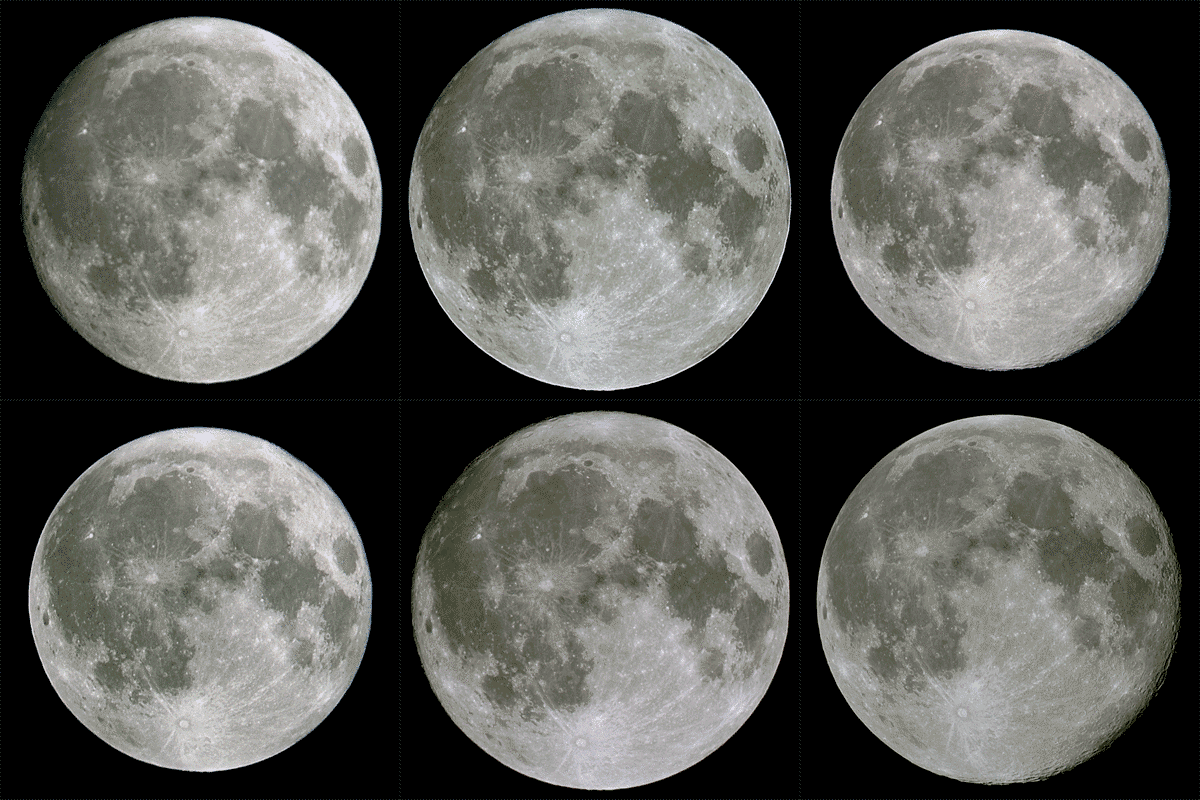
The back-and-forth nodding of Io in its orbit means that the tidal bulge moves back and forth, too; and as its insides deform to accommodate the bulge's motion, energy is dissipated as heat. Being so close to such an enormous planet with such a fast and so elliptical orbit (Io orbits Jupiter once every 42.5 hours), the amount of energy sunk into the little world by this back-and-forth motion of the tidal bulge produces a LOT of heat. Enough to drive continuous volcanism from dozens of volcanoes, making the most geologically active world in the solar system.
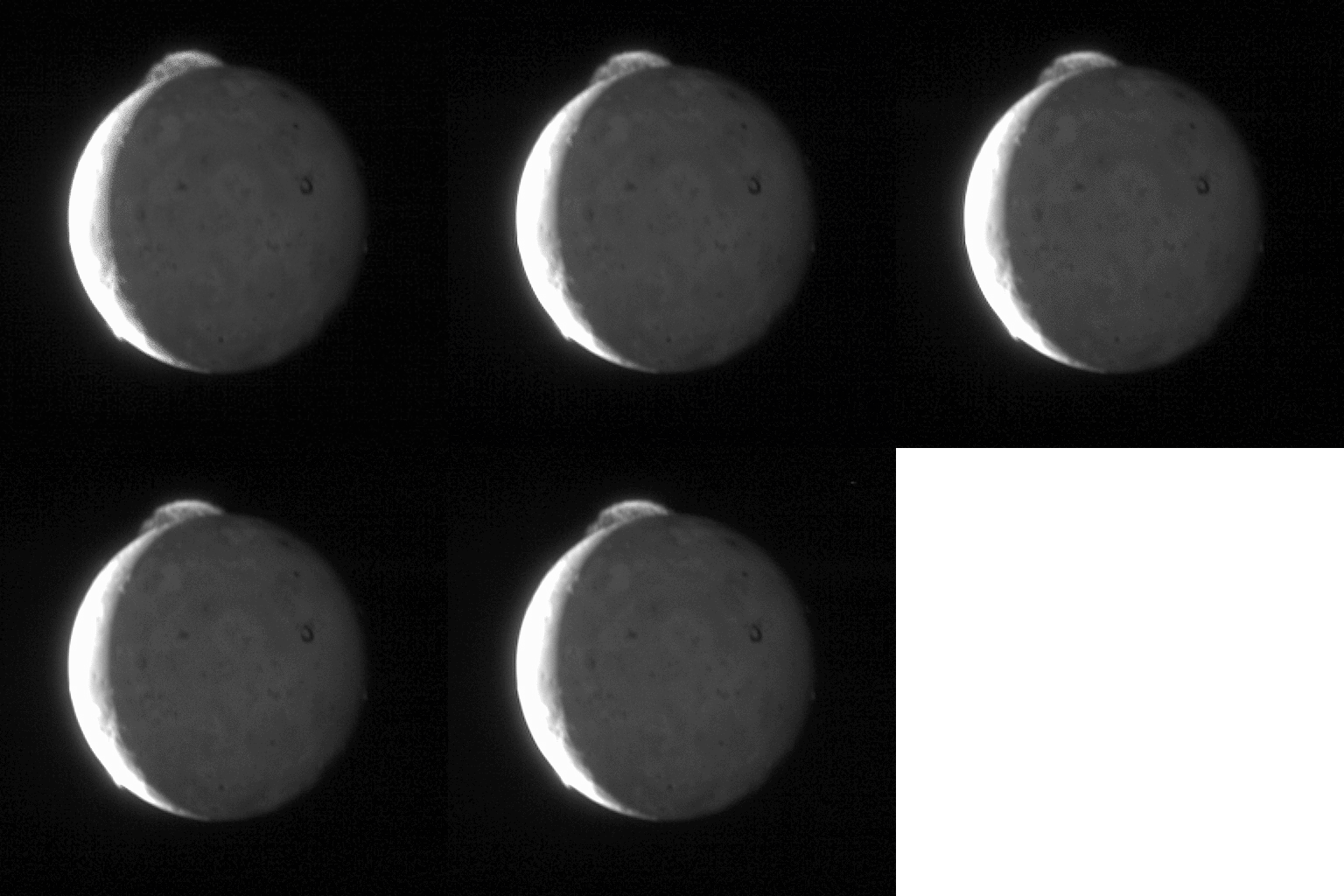
The active volcanoes were first discovered in Voyager images, of course. The lavas that came out of those volcanoes were initially thought to be composed of sulfur (in part because of the bright colors on Io's surface, a result of sulfur compounds). Now, though, we know that Io's volcanoes spew molten rock, just like Earth's. Diana Blaney and her coauthors have estimated that 500 cubic kilometers of liquid hot magma erupt onto Io's surface every year; this is more than a hundred times what comes out of all of Earth's volcanoes, even when you include the mid-ocean ridges that nobody sees.
Orbiting and flyby spacecraft, namely the Voyagers, Galileo, Cassini, and New Horizons, have provided our most dramatic views of Io's erupting volcanoes. Just as on Earth, there are lots of different kinds of volcanoes on Io, everything from fire fountains to lava lakes.

There are even small, isolated, cone-shaped volcanoes, like Zamama (though this cone is considerably flatter than cone-shaped volcanoes we're used to on Earth, due to the more mafic composition of its lava):

The Davies et al paper explains that with a relatively simple measurement -- a ratio of how bright an erupting volcano appears to be at two different near-infrared wavelengths, around 2 and around 5 microns -- astronomers can determine not only the fact that a volcano is erupting, but also what kind of eruption it is. Some kinds of eruptions include: lava fountains; lava flows; lava lakes; lava domes; insulated flows; and tube-fed flows.
This is clearly useful for the future Jupiter mission, which may have a few flybys of Io but will mostly orbit Europa and thus only be able to observe Io from a distance: "The ability to identify and track individual volcanic eruptions from a distance based on a few wavelengths of data will greatly increase the return of Io science per returned byte of data," Ashley and his coauthors remark. Although beneficial, an orbiter is no longer required to determine the eruption style of Io's volcanoes: "We now have sufficient data to constrain eruption style using the new Adaptive Optics-enabled multi-wavelength data for Io's volcanism."
Speaking of which, Franck Marchis is one of the astronomers doing just that kind of work, and he recently posted to his blog some images of Io, erupting, taken with the Adaptive Optics-equipped Keck II telescope.

But wait, there's more. The ratio method that Davies et al. describe can also be used on Earth. It was derived to deal with the low resolution of data available for Io, but can be turned around to be applied for Earth volcano monitoring, one of many important inputs into climate studies (not to mention the importance for local populations of monitoring natural hazards).
The paper was published in a fairly obscure journal (obscure, that is, to me): the Journal of Volcanology and Geothermal Research. And it wasn't press released, either. So how did I find out about the study? Because Ashley proactively emailed me (and lots of other people) a copy of the paper. Good on you, Ashley! Other scientists take note! I won't promise to write about every paper I receive. But I do promise at least to read the abstract and conclusions and look at the pretty pictures, so I'll be familiar with your work when I write about the fields you work in.
Protect Our Shared Future
You help us defend humanity and prevent asteroid impacts. Donate now to become a Planetary Defender!
Donate