

 Explore Worlds
 Find Life
 Defend Earth

Arecibo saves us from another potentially hazardous asteroid

Written by
Emily Lakdawalla
April 29, 2010
That's a bit of an overdramatic title, but it's true that the most efficient way for us to reduce the risk we face from asteroids that have a very small chance of hitting Earth in the future is to determine their orbits more precisely. As surveys get better and better at picking up smaller and smaller objects, we are going to be hearing about more and more bodies that have slight chances -- one in a million chances -- of hitting Earth. But these small things are very hard to follow up on because they are so small, so their orbital paths can remain uncertain. It's bad for future planning not to really know whether we're going to be hit by something or not. So it's wonderful to have radio telescopes like Arecibo that can bounce signals off of asteroids to determine their position (and, incidentally, their size) very precisely.
That's what Arecibo did last week, bouncing a signal off of near-Earth asteroid 2005 YU55. As its name suggests, 2005 YU55 was discovered in 2005; actually it was discovered right at the end of 2005 (that's what the "Y" tells you), presumably when it was relatively close to Earth. It has an orbital period of 1.22 years, so it's had about three orbits of the Sun for the roughly four Earth orbits of the Sun since 2005 YU55 last approached Earth. This time, it came quite close in solar system terms, within about 2.3 million kilometers.
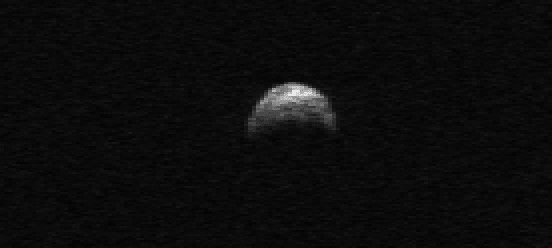
Could it come closer in the future? Definitely. In fact, with the information that we had on its orbit before April, the uncertainty in its orbital data left us with a one-in-ten-million chance that 2005 YU55 could hit Earth some time in the next 100 years. This is a small chance, to be sure, but 2005 YU55 is not a small object; it was estimated to be 200 meters or so in diameter, big enough to make a crater a few kilometers across on Earth. So it bore watching.
Well, from April 19 to 23, Arecibo watched and tracked it. Within a couple of days, the data had allowed astronomers to refine 2005 YU55's orbit, reducing the uncertainty in its position by 50 percent. That was enough that there were no longer any conceivable future paths for the asteroid that intersected Earth, at least for the next 100 years, and 2005 YU55 has now been removed from the watch list. (Incidentally, the Arecibo data also revealed that the asteroid was actually about 400 meters across, twice as large and therefore an order of magnitude more massive -- and dangerous, if it really were an impact risk -- than previously thought.)
We do need to learn how to "tag" and track asteroids if we ever do find something that is a more definite impact risk, but it is nice not to have to consider sending spacecraft to rendezvous with many potentially hazardous bodies; we can track them just fine from Earth as long as we have sufficiently large radio telescopes to do the job. So we need to make sure that Arecibo stays in operation.
You Power the Next Great Discovery!
Fund future scientific research that advances space science and exploration with your gift today.
Donate