

 Explore Worlds
 Find Life
 Defend Earth


Petrographic thin section of Apollo 11 sample 10062
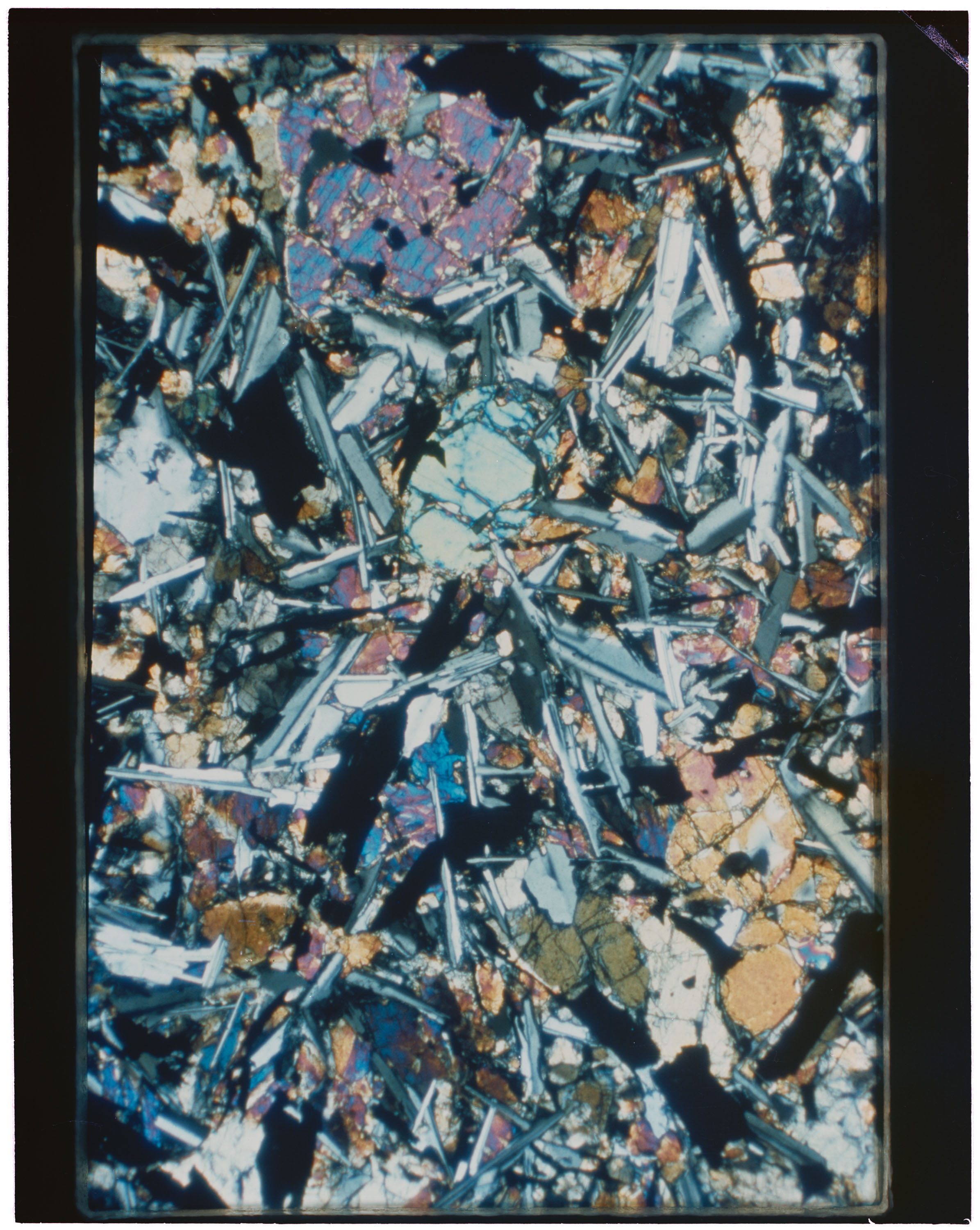
Minerals become vibrantly colorful when viewed in "cross nichols" light. A petrographic microscope bears two polarizing filters, one fixed and one that can be rotated. When the two are rotated to the same orientation, the thin section looks like it does in regular transmitted light (see below). But when the rotatable polarizing filter is turned sideways so that it's perpendicular to the fixed one, holes in the rock go black, while minerals, whose regular crystal structure rotates polarized light, leap into color.
More about this sample: Apollo 11 Sample 10062
