join-tab.png
close-x.png

Help Shape the Future of Space Exploration

Join The Planetary Society Now  arrow.png

enews-tab.png
close-x.png

Join our eNewsletter for updates & action alerts

    Please leave this field empty
Multimedia
Facebook Twitter Email RSS AddThis

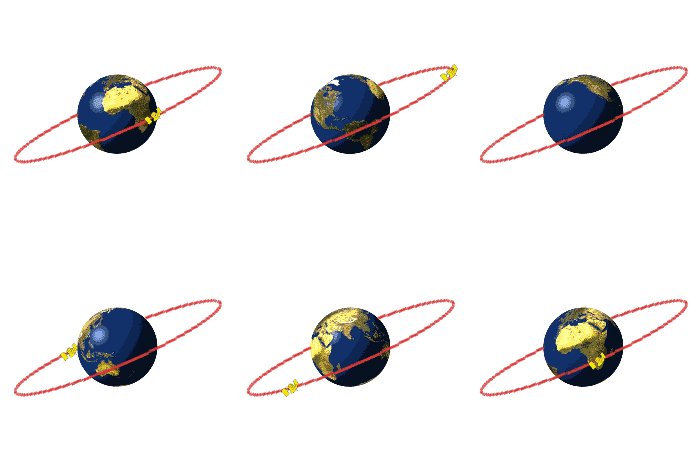
Geostationary orbit

Filed under animation, trajectory diagrams, Earth

Go Back

Geostationary orbit To achieve a geostationary orbit, a geosynchronous orbit is chosen with an eccentricity of zero, and an inclination of either zero, right on the equator, or else low enough that the spacecraft can use propulsive means to constrain the spacecraft's apparent position so it hangs seemingly motionless above a point on Earth. (Any such maneuvering on orbit, or making other adjustments to maintain its orbit, is a process called station keeping.) The orbit can then be called geostationary.

NASA / JPL ("The Basics of Space Flight")

This orbit is ideal for certain kinds of communication satellites and meteorological satellites. The idea of a geosynchronous orbit for communications spacecraft was first popularized by science fiction author Sir Arthur C. Clarke in 1945, so it is sometimes called the Clarke orbit.

Read more about orbits at The Basics of Space Flight.

Comments:

Leave a Comment:

You must be logged in to submit a comment. Log in now.

Fly to an Asteroid!

Send your name and message on Hayabusa-2.

Send your name

Join the New Millennium Committee

Let’s invent the future together!

Become a Member

Connect With Us

Facebook! Twitter! Google+ and more…
Continue the conversation with our online community!

facebook.png twitter.png rss.png youtube.png flickr.png googleplus.png