Pictures of Earth by Planetary Spacecraft
Lunar Orbiter sent back the first photo of Earth over the Moon, but it was the Apollo program that produced the first widely publicized views of Earth as a colorful marble floating in black space, images that revolutionized public perception of our fragile planet. At the same time, Soviet Zond spacecraft were capturing similarly dramatic images. Later, Clementine reprised these views. As spacecraft began to launch on journeys to more distant planets, never to return, their mission controllers often commanded them to take departing views of Earth and the Moon. Mariner 10 and Voyager 1 both took such snapshots, as did Mars Odyssey and Venus Express. Other spacecraft traveling to eventual orbit around other planets required one or more gravity-assist flybys of Earth; a year or more after their launches, Galileo, Hayabusa, Rosetta, and MESSENGER returned to the neighborhood, shooting photos and even movies as they flew by. Some planetary travelers -- like Voyager 1, Mars Global Surveyor, Cassini, Deep Impact, the Mars Exploration Rover Spirit and Mars Reconnaissance Orbiter -- were even able to turn toward Earth and capture distant glimpses of their home planets from their eventual destinations. Wthe dawning of an International Lunar Decade and multiple missions returning to the Moon, new views came in from Kaguya, Chandrayaan-1, and Chang'E. Most recently, GRAIL's little MoonKAM has returned photos of Earth from the Moon.
Below are just a few of these photos. Over time, more images will be added.
In this rare image taken on July 19, 2013, the wide-angle camera on NASA's Cassini spacecraft has captured Saturn's rings and our planet Earth and its Moon in the same frame.
Filed under pretty pictures, many worlds, pics of Earth by planetary missions, Earth, the Moon, Saturn, Saturn's rings, Cassini
The Kaguya lunar orbiter sees the Earth as the spacecraft passes beneath the south pole of the moon. Africa is visible at the right.
Filed under pretty pictures, pics of Earth by planetary missions, Earth, the Moon, Japanese lunar missions
A solar eclipse - as viewed from the Moon
Lunar Reconnaissance Orbiter performed a challenging feat, catching the Moon's shadow crossing the full Earth's disk a total of four times during the May 12, 2012 solar eclipse. Click here for an animation of all four images. Visit the Lunar Reconnaissance Orbiter Camera website to learn more about how it was taken.
Filed under pics of Earth by planetary missions, Earth, Lunar Reconnaissance Orbiter, solar eclipse
This is a mosaic of 11 images taken during a ten-minute period near 5:45 p.m. PST Dec. 8, 1990. The picture spans about 1,600 miles across the south polar latitudes of our planet. The morning day/night terminator is toward the right. The South Pole is out of sight below the picture; the visible areas of Antarctica are those lying generally south of South America. The violet-blue envelope of Earth's atmosphere is prominent along the limb to the left. At lower left, the dark blue Amundsen Sea lies to the left of the Walgreen and Bakutis Coasts. Beyond it, Peter Island reacts with the winds to produce a striking pattern of atmospheric waves.
Filed under pretty pictures, pics of Earth by planetary missions, Earth, Galileo
Apollo 11 view of a crescent Earth
On their return trip to Earth from the Moon, the Apollo 11 astronauts photographed Earth as a crescent.
Filed under pretty pictures, global views, pics of Earth by planetary missions, Earth, NASA lunar missions before 2005
The MESSENGER spacecraft, en route to Mercury, gets a gravity boost by flying by the home planet. With its jewel-like seas and clouds, it is immediately clear that this world is unique in the Solar System.
Filed under pretty pictures, amateur image processing, pics of Earth by planetary missions, Earth, MESSENGER
This unusual photo of a crescent Earth was taken by the OSIRIS wide-angle camera on Rosetta about two hours before closest approach on its second Earth flyby, at 19:05 UTC on November 13, 2007. Antarctica lies at the bottom of the crescent.
Filed under pretty pictures, global views, pics of Earth by planetary missions, Earth, Rosetta and Philae
Crescent Earth and Moon from Voyager 1
This picture of a crescent-shaped Earth and Moon -- the first of its kind ever taken by a spacecraft -- was recorded Sept. 18, 1977, by Voyager 1 when it was 11.66 million kilometers (7.25 million miles) from Earth.
Filed under pretty pictures, global views, many worlds, pics of Earth by planetary missions, Earth, the Moon, Voyager 1 and 2
Rosetta viewed Earth in a thin crescent phase as it approached for its November 13, 2009 flyby. This image is one in a series taken to make an animation of the rotating Earth over a 24-hour period.
Filed under pretty pictures, global views, pics of Earth by planetary missions, Earth, Rosetta and Philae
JAXA's spacecraft, variously named Planet-C, Venus Climate Orbiter, and Akatsuki (or "dawn"), launched on May 17, 2010 for a quick flight to our nearest solar system neighbor.
Filed under pretty pictures, pics of Earth by planetary missions, Earth, Akatsuki (Planet-C)
On December 16, 1992, eight days after its encounter with Earth, the Galileo spacecraft looked back from a distance of about 6.2 million kilometers to capture this remarkable view of the Moon in orbit about Earth.
Filed under pretty pictures, many worlds, pics of Earth by planetary missions, Earth, the Moon, Galileo
Earth and Moon as Seen from Mars Orbit
This image of Earth and the moon was captured on October 3, 2007 by the HiRISE camera on NASA's Mars Reconnaissance Orbiter.
Filed under pretty pictures, pics of Earth by planetary missions, Earth, Mars Reconnaissance Orbiter, many worlds
Earth and the Moon as seen by Mars Reconnaissance Orbiter CTX
As it sped away from Earth on September 8, 2005, Mars Reconnaissance Orbiter turned to the crescent-phase Earth-Moon system, focusing on the Moon to test and calibrate its cameras.
Filed under pretty pictures, pics of Earth by planetary missions, Earth, the Moon, Mars Reconnaissance Orbiter
Earth and the Moon from Clementine
Clementine peered over the limb of the Moon on March 13, 1994 to view a distant, nearly full-disk Earth.
Filed under pretty pictures, global views, many worlds, pics of Earth by planetary missions, Earth, the Moon, NASA lunar missions before 2005
Earth and the Moon from Galileo
Earth and the Moon seen on December 8, 1992, by the Galileo spacecraft. The images have been processed to produce color similar to what the human eye would see; the Moon really is that much darker and redder than Earth.
Filed under pretty pictures, many worlds, amateur image processing, pics of Earth by planetary missions, Earth, the Moon, Galileo
Earth and the Moon from Mercury
The pair of bright star-like features in the upper panel are not stars at all, but the Earth and Moon! MESSENGER took the photo on July 19, 2013, from a distance of 98 million kilometers. Earth and Moon are both overexposed; the image was part of a long-exposure search for satellites around Mercury.
Filed under pretty pictures, pics of Earth by planetary missions, Earth, the Moon, MESSENGER
Earth as seen from Akatsuki's UV camera
As Akatsuki sped away from Earth, it captured "First Light" images with its optical instruments pointed at its home planet in an extreme UV phase. This view is from the UVI camera, which captures images at a near-ultraviolet wavelength of 365 nanometers.
Filed under pretty pictures, pics of Earth by planetary missions, Earth, Akatsuki (Planet-C)
Chandrayaan-1 took this photo of Earth from Earth orbit on October 29, 2008 at 07:00 UTC. Near the center of the disk is the northwestern coast of Australia; the Sun glints off the Indian Ocean adjacent to that coast. This image has been flipped horizontally from its originally published version to match the proper orientation.
Filed under pretty pictures, pics of Earth by planetary missions, Earth, Chandrayaan-1
Hayabusa snapped this image of Earth during its flyby on May 18, 2004 at 15:00 UTC. Four of Earth's continents are clearly visible -- North America at left, South America at the bottom, Africa on the right, and eastern Europe above it.
Filed under pretty pictures, global views, pics of Earth by planetary missions, Earth, Hayabusa (MUSES-C)
Kaguya took this photo of Earth using its HDTV camera from a distance of 110,000 kilometers (68,000 miles). It is the farthest that any HDTV camera has ever traveled from Earth. This is a still image, but it was taken as part of a test of the camera's a
Filed under pretty pictures, pics of Earth by planetary missions, Earth, Japanese lunar missions
Lunar Reconnaissance Orbiter turned toward a mostly cloud-free view of Earth's western hemisphere on August 9, 2010.
Filed under pretty pictures, global views, pics of Earth by planetary missions, Earth, Lunar Reconnaissance Orbiter
Earth in true and false color as seen by MESSENGER
This pair of images represents the same viewpoint on Earth through two different sets of filters on the MESSENGER spacecraft. On top, three filters in red, green, and blue wavelengths were combined to make an image that approximates what the human eye would see. The green mass at the center is the Amazon jungle of South America. The deserts of West Africa are just visible on the edge of the Earth's disk below and to the right of South America. The bottom image is "pushed" into the near infrared; instead of red, green, and blue, it is composed of images taken through near-infrared, red, and green filters. Chlorophyll, the green pigment in plant leaves, is very strongly reflective at near infrared wavelengths, much more so than it is in red or green wavelengths, so the vegetated parts of Earth burst into bright red color.
Filed under pretty pictures, global views, pics of Earth by planetary missions, Earth
As Galileo receded from its first flyby of Earth on December 11 and 12, 1990, it took images of Earth in six different filters almost every minute over a 25-hour period. The animation here includes images taken once an hour, representing about a tenth of the full number of frames.
Filed under pretty pictures, animation, global views, amateur image processing, pics of Earth by planetary missions, Earth, Galileo
Earth-Moon System Seen by the Departing Mars Express
The Mars Express orbiter took this farewell shot of home as it left for the Red Planet.
Filed under pretty pictures, pics of Earth by planetary missions, Earth, the Moon, Mars Express
Earthrise over the lunar horizon from Apollo 8
Earth rose over the lunar horizon as Apollo 8 completed the first manned trip behind the far side of the Moon. The mission also returned the first live television coverage of the lunar surface, on December 24, 1968.
Filed under pretty pictures, global views, pics of Earth by planetary missions, human spaceflight, Earth, the Moon, NASA lunar missions before 2005
Zond 7 flew past the Moon, taking this sequence of images of Earth setting behind the lunar limb, on August 9, 1969. The sequence actually consists of only three images; the second one was simulated from data in the others to even out the Earthset sequence.
Filed under pretty pictures, many worlds, amateur image processing, pics of Earth by planetary missions, Earth, the Moon, Soviet lunar missions
Galileo view of an Earth-Moon conjunction
As Galileo receded from its ssecond flyby of Earth on December 16 and 17, 1992, it captured this sequence of Earth rotating as the Moon zipped by on its orbit. There are 56 frames in total, each separated by 15 minutes, spanning about 14 hours.
Filed under pretty pictures, animation, many worlds, amateur image processing, pics of Earth by planetary missions, Earth, the Moon, Galileo
These images were taken during Galileo's first Earth flyby. In each frame, the continent of Antarctica is visible at the bottom of the globe. South America may be seen in the first frame (top left), the great Pacific Ocean in the second (bottom left), India at the top and Australia to the right in the third (top right), and Africa in the fourth (bottom right).
Filed under pretty pictures, pics of Earth by planetary missions, Earth, Galileo
This is the final photo captured by Hayabusa as it approached its reentry into Earth's atmosphere. It was taken roughly an hour before the end of the mission, after it had already released the sample capsule.
Filed under pretty pictures, amateur image processing, pics of Earth by planetary missions, Earth, Hayabusa (MUSES-C)
Iconic view of Earth from Apollo 17
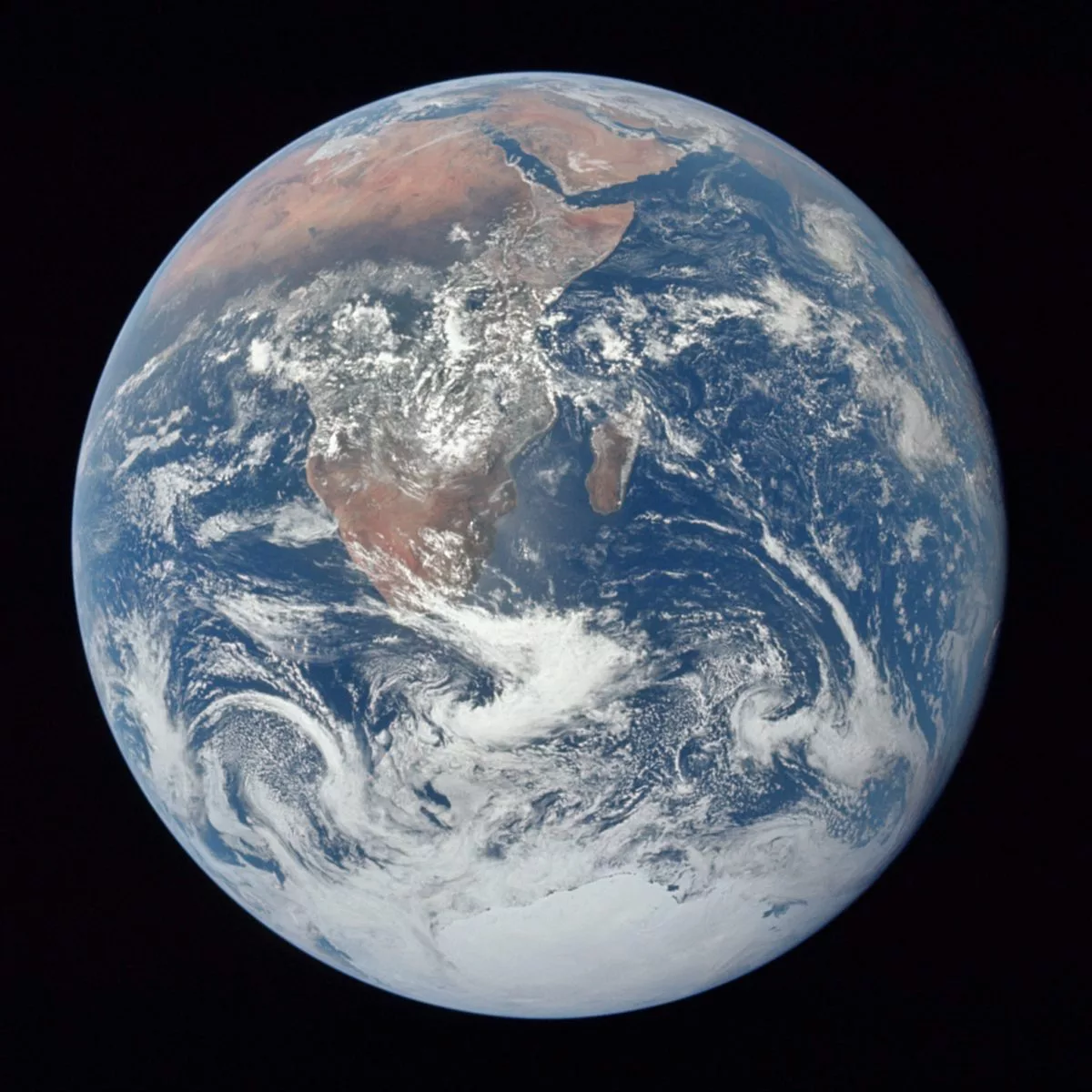
One of the most famous images of the twentieth century, this view of the fully lit globe of Earth was taken from Apollo 17 shortly after its launch on December 7, 1972. The full view was enabled by the fortuitous alignment of Earth, spacecraft, and the Sun.
Filed under best of, pretty pictures, global views, pics of Earth by planetary missions, human spaceflight, Earth, NASA lunar missions before 2005
Image of Earth from Chandrayaan-1
Chandrayaan-1 captured this view of a nearly full Earth on March 25, 2009 at 07:03:03 UTC. India is at the center of the image.
Filed under pretty pictures, global views, pics of Earth by planetary missions, Earth, Chandrayaan-1
With giant Saturn hanging in the blackness and sheltering Cassini from the Sun's blinding glare, the spacecraft viewed the rings as never before, revealing previously unknown faint rings and even glimpsing its home world.
Filed under best of, pretty pictures, global views, pics of Earth by planetary missions, Saturn, Saturn's rings, Cassini
MESSENGER's receding view of Earth (movie)
As MESSENGER retreated from its August 2, 2005 flyby of Earth, it captured a full day's worth of images of Earth's receding crescent, which were assembled into a movie. This animation contains only 17 of the 358 frames captured by MESSENGER.
Filed under pretty pictures, animation, global views, pics of Earth by planetary missions, Earth, MESSENGER
Moonrise over Earth's limb from Rosetta
As Rosetta flew past Earth for the first of two gravity-assist flybys on March 3, 2005, one of its Navigation Cameras caught the Moon rising above the Pacific. The photo was taken at 22:06 UTC, just three minutes before its closest approach.
Filed under pretty pictures, many worlds, amateur image processing, pics of Earth by planetary missions, Earth, the Moon, Rosetta and Philae
Rosetta looks back at Earth (corrected orientation)
After its closest approach to Earth, Rosetta looked back and took a number of images using the spacecraft's Optical, Spectroscopic, and Infrared Remote Imaging System (OSIRIS) Narrow Angle Camera (NAC). This image, acquired November 15, 2007, is a color composite of the NAC Orange, Green, and Blue filters. At the bottom, the continent of Australia can be seen clearly.
Filed under pretty pictures, global views, pics of Earth by planetary missions, Earth, Rosetta and Philae
The SMART-1 lunar probe, a European Space Agency mission, captured this sequence of images as the Earth disappeared behind the moon and then re-emerged. The prominent landform is Brazil.
Filed under pretty pictures, animation, pics of Earth by planetary missions, Earth, the Moon
The Moon transiting Earth, as seen from Deep Impact
As part of its EPOXI mission, Deep Impact spent 24 hours over May 28 and 29, 2008, watching Earth from a distance of 50 million kilometers. During that time, the Moon transited Earth as seen from the spacecraft. The view was captured using Deep Impact's High Resolution Imager, which had a serious blurring problem; efforts to reduce the blurring have introduced some other artifacts, like the concentric ringing on the Moon.
Filed under pretty pictures, global views, many worlds, amateur image processing, pics of Earth by planetary missions, Earth, the Moon, Deep Impact
The Moon transiting Earth, as seen from Deep Impact (animation)
As part of its EPOXI mission, Deep Impact spent 24 hours over May 28 and 29, 2008, watching Earth from a distance of 50 million kilometers. During that time, the Moon transited Earth as seen from the spacecraft. The view was captured using Deep Impact's High Resolution Imager, which had a serious blurring problem; efforts to reduce the blurring have introduced some other artifacts, like the concentric rings on the Moon. The full sequence covers 24 hours, a full rotation of Earth.
Filed under pretty pictures, global views, many worlds, amateur image processing, pics of Earth by planetary missions, Earth, the Moon, Deep Impact
The Moon transiting Earth, as seen from Deep Impact (sequence)
As part of its EPOXI mission, Deep Impact spent 24 hours over May 28 and 29, 2008, watching Earth from a distance of 50 million kilometers. During that time, the Moon transited Earth as seen from the spacecraft. The view was captured using Deep Impact's High Resolution Imager, which had a serious blurring problem; efforts to reduce the blurring have introduced some other artifacts, like the concentric rings on the Moon. These eight images were captured about half an hour apart, so the whole sequence spans about 3.5 hours.
Filed under pretty pictures, amateur image processing, pics of Earth by planetary missions, Earth, the Moon, Deep Impact
The Solar System Family Portrait
Voyager 1's last view, looking back on every planet in the solar system.
Filed under best of, pretty pictures, history, many worlds, pics of Earth by planetary missions, the Sun, Earth, Mars, Jupiter, Saturn, Uranus, Neptune, Voyager 1 and 2
There's a Beautiful Earth Out Tonight
A full Earth rises over the lunar horizon, as seen by the Kaguya lunar orbiter.
Filed under pretty pictures, pics of Earth by planetary missions, Earth, the Moon, Japanese lunar missions
On September 18, 1968, Zond-5 became the first spacecraft to circle the Moon and return to land on Earth. It photographed Earth from a distance of 90,000 kilometers, but a subsequent malfunction of the orientation system prevented it from photographing the Moon.
Filed under pretty pictures, global views, pics of Earth by planetary missions, Earth, Soviet lunar missions
Zond-6 flew around the Moon on November 14, 1968. It carried the AFA-BAM camera with a 400-millimeter objecitve, shooting on 13 by 18-centimeter frames of isopanchromatic film. A session of 111 frames was performed at a distance of 9,290-6,843 km, and another session of 58 frames from 2,660-2,430 km. A crash landing on Earth flattened and broke open the film canister, but 52 photographs were recovered with some degree of laceration and fogging. Only a few fragments of Zond-6 images have been published. Poor print quality, not film damage, is the reason for the low quality of this image.
Filed under pretty pictures, many worlds, pics of Earth by planetary missions, Earth, the Moon, Soviet lunar missions
Zond-7 photographed Earth on August 9 and performed two photo sessions at the Moon on August 11, 1969.
Filed under best of, pretty pictures, global views, amateur image processing, pics of Earth by planetary missions, Earth, Soviet lunar missions
Zond-8 flew by the Moon on October 24, 1970 and returned to Earth with high quality photographs, some from as close as 1,350 km. Images were shot with the 400 mm AFA-BAM camera, on 13 by 18-centimeter frames of isopanchromatic film. A session of 20 full-Moon pictures was followed by a session of 78 lunar-surface pictures (including 17 shots of Earth over the lunar horizon).
Filed under pretty pictures, animation, many worlds, pics of Earth by planetary missions, Earth, the Moon, Soviet lunar missions
Zond-8 flew by the Moon on October 24, 1970 and returned to Earth with high quality photographs, some from as close as 1,350 km. Images were shot with the 400 mm AFA-BAM camera, on 13 by 18-centimeter frames of isopanchromatic film. A session of 20 full-Moon pictures was followed by a session of 78 lunar-surface pictures (including 17 shots of Earth over the lunar horizon).
Filed under pretty pictures, many worlds, pics of Earth by planetary missions, Earth, the Moon, Soviet lunar missions
JOIN THE
PLANETARY SOCIETY
Our Curiosity Knows No Bounds!
Become a member of The Planetary Society and together we will create the future of space exploration.
Support our Asteroid Hunters
They are Watching the Skies for You!
Our researchers, worldwide, do absolutely critical work.
Asteroid 2012DA14 was a close one.
It missed us. But there are more out there.