

 Explore Worlds
 Find Life
 Defend Earth

Planetary Society statement entered into testimony for House hearing on future of planetary science

Written by
Charlene Anderson
November 15, 2011
Today, The Planetary Society entered the following statement into testimony for the hearing "Exploring Mars and Beyond: What Next for U.S. Planetary Science?" held by the Subcommittee on Space and Aeronautics of the U.S. House Committee on Science, Space and Technology.
Statement by The Planetary Society Before the Subcommittee on Space and Aeronautics Committee on Science, Space, and Technology U.S. House of Representatives
Hearing: Exploring Mars and Beyond: What's Next for U.S. Planetary Science?
November 15, 2011
"Of all discoveries and opinions, none may have exerted a greater effect on the human spirit than the doctrine of Copernicus. The world has scarcely become known as round and complete in itself when it was asked to waive the tremendous privilege of being the center of the universe."
- Johann Wolfgang von Goethe
In the 16th Century, Nicolaus Copernicus proposed a revolutionary theory -- that the Earth revolves around the Sun, just like any other planet. This event stands as a seminal moment in human history. Copernicus' theory, coupled with subsequent discoveries in astronomy and planetary science, is the spark that ignited the scientific revolution. This intellectual awakening laid the foundation for modern science including physics, chemistry, biology and medicine, as well as engineering and technology. These discoveries in turn led to revolutions in religion, philosophy, and politics, which brought about the Age of Enlightenment, eventually led to the American Revolution, and fundamentally influenced American ideals and our way of life. It is impossible to overemphasize the impact that the study of the Cosmos has had on humankind, the human spirit, and our collective search for our place in the Universe. Yet, there is still much to learn.
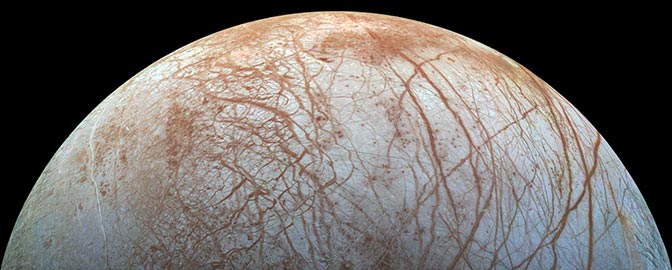
We stand at the dawn of a similar period in which our knowledge and understanding of the Universe is poised to take another giant leap forward. Recent planetary science missions reveal a solar system filled with worlds begging for further exploration. Recent discoveries include water ice on the Moon's poles, evidence for an early warm and wet climate with potential conditions for life on Mars, liquid oceans under the surface of Jupiter's moon Europa, and liquid hydrocarbon lakes on Saturn's moon Titan. At the same time, astronomers have discovered hundreds of new planets orbiting other stars, allowing scientists to study how other planetary systems formed and how they behave so we can learn more about our own.
Protect Our Shared Future
You help us defend humanity and prevent asteroid impacts. Donate now to become a Planetary Defender!
Donate