

 Explore Worlds
 Find Life
 Defend Earth


More Dawn Vesta approach images: First color views

Written by
Emily Lakdawalla
February 17, 2012
I'm trying to savor the new Dawn data, and thought briefly about processing it in simulated real time -- which would have meant that, after the first Vesta approach animation I posted on Tuesday, I should have waited ten days before posting any more. Dawn didn't take images continuously as it approached. Unlike chemically propelled spacecraft, which spend most of their time coasting and consequently have free time to gawk about, ion-powered Dawn had to work her engines all the way in to orbit in order to catch up to Vesta at just the right speed and direction. Whenever Dawn took optical navigation images, the thrusting had to stop. So the optical navigation images that I posted before were taken in sets of about 20, once a week at first, and then, as Vesta got closer, twice a week.
But on June 28, when NASA got in touch with Dawn to receive the 11th expected set of approach optical navigation images, they got a rude surprise: Dawn was in safe mode due to a cosmic ray hit to one of the ion propulsion system computer controllers. As Marc Rayman explained in his July 18 Dawn Journal, the team restored the spacecraft to normal flight mode within the day. But they'd already missed the 11th optical navigation session, and because Dawn had not been thrusting during the time she was in safe mode, they were forced to make up for lost time and cancel the 12th set of planned optical navigation images, as well as two planned comm sessions, replacing all that time with thrusting. (Oddly, the compensatory thrusting wound up shifting Dawn's arrival at Vesta earlier than originally planned, by 15 hours.)
But they kept in a crucial observation, the first "rotation characterization" of Vesta. On June 30, Dawn stopped thrusting for a full Vestian day -- five hours and 20 minutes -- and just watched the asteroid rotate. But unlike the previous observations, they used all of Dawn's color filters to acquire the best-ever color photos of the lumpy world. (Best ever, that is, on the day they were taken. The best-ever images are being acquired as I write, with Dawn still in low-altitude mapping orbit at Vesta.)
Here's an animation composed of 12 color images made with red, green, and blue filters, so it's an attempt to approximate true color. Keep in mind that I can't vouch for the accuracy of the slightly greenish-grayish brown that Vesta appears here, because I didn't try to color-calibrate the images (and I'm not sure I would be able to). But I can vouch for the accuracy of the variations among the colors on the surface. There's dark colorful splats and bright splashes; and then there's that wrinkly nose of a mountain that sprouts from Vesta's south pole. This is the first set of Dawn's images where it's really obviously clear that we're looking at a lumpy, cratered mini-planet, and not just a fuzzy blob.
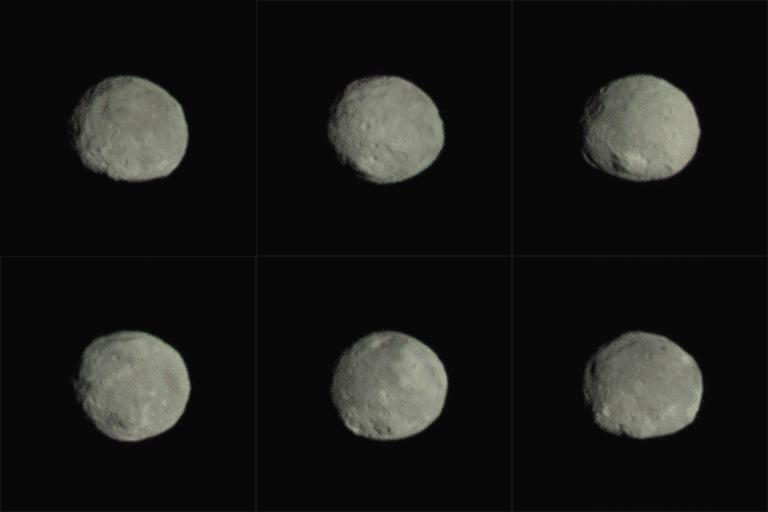
While playing with these photos it became clear that all the images in the data set are mirror-reversed. (This isn't a mistake on the Dawn team's part; mirroring happens multiple times from the moment that photons enter a camera's optics to the moment their charge gets read off of the CCD, and whether the images appear "right way around" in any instrument's raw data is up to chance.) I didn't notice it in the earlier, lower resolution images I posted, but it's obvious now, so I've flipped my versions to compensate.
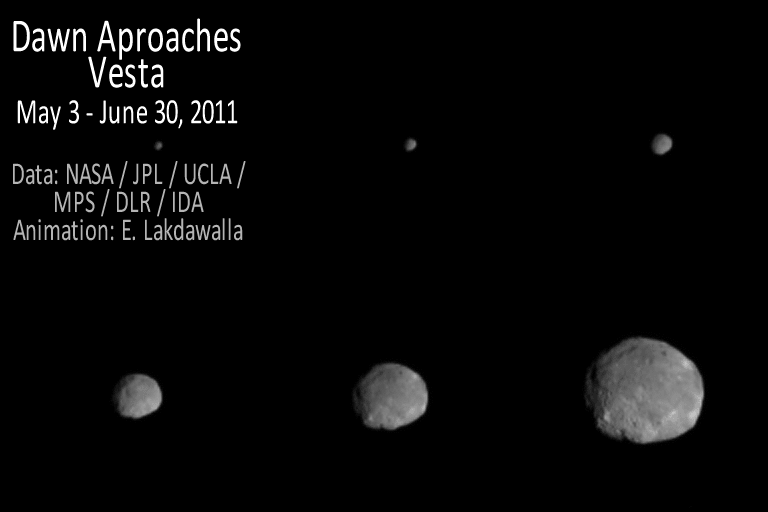
So here's an updated approach animation, with the clear frames from that first rotation characterization included. The jump in size to the last set of images is an artifact of that safe mode event. The next set of images was acquired four days later, on July 4. Shall I wait four days now to check them out?
Protect Our Shared Future
You help us defend humanity and prevent asteroid impacts. Donate now to become a Planetary Defender!
Donate