

 Explore Worlds
 Find Life
 Defend Earth


New Horizons Day 2: Tectonic features on icy worlds

Written by
Emily Lakdawalla
September 9, 2011
I began this blog entry eight days ago, in the car on the way downhill to Phoenix from Flagstaff, where I'd just spent two busy days at the New Horizons Workshop on Icy Surface Processes, but I haven't had time to return to it until today. The workshop was intended to help the New Horizons team predict what they might see at Pluto based on what we've seen on other icy worlds of the outer solar system. The first day of the conference was about chemistry and atmospheres, and I wrote that up a week ago. The second day was about geology and geophysics, which is my bailiwick, so I took a ton more notes. So many, in fact, that this long post just covers the first talk!
Simon Kattenhorn kicked the day off with a presentation on tectonics. I should probably define "tectonics." It's a field of study that is concerned with how the solid outer shells of worlds deform when they're put under stress. There are people who study tectonics "in the field" by mapping tectonic structures that we can see like mountains and rifts and faults and folds, and there are people who study it by developing computer models to examine where these stresses come from and how they're likely to deform rock or ice. Most people do both mapping and modeling. So it's a field that combines pretty pictures, fieldwork, and physics, a combination I always loved.
So, back to Kattenhorn's presentation. "Let's start," he said, "with what we know about the tectonics of Pluto." His next slide showed the current best image of Pluto and was otherwise blank but for the text "there are difficulties." Which earned him a laugh from the crowd.

Of course this was meant as an explanation of why in a meeting about Pluto Kattenhorn was going to proceed to talk about other icy bodies in the solar system, a common theme for the rest of the day. The idea is to compare the wide variety of icy moons and determine trends with size, composition, or solar system location, and try to infer from those trends what we might find at Pluto and Charon. Here's a kind of old size comparison I put together of these bodies -- I need to update it, not all of the sizes are the most up-to-date numbers, but it's good enough to provide context. If you just consider size, note that Pluto naturally lumps in with the bigger icy moons including the Galilean satellites of Jupiter plus Titan and Triton, while Charon naturally lumps in with the mid-sized icy moons of Saturn and Uranus.
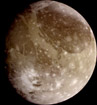 | 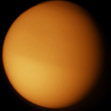 |  |
| Ganymede 5,262 km | Titan 5,150 km | Callisto 4,821 km |
Io |
Europa |
Triton |
Pluto |


 |  |  |  |  |
| Titania 1,578 km | Rhea 1,528 km | Oberon 1,523 km | Iapetus 1,436 km | Charon 1,207 km |
 |  |  |  |  |
| Umbriel 1,169 km | Ariel 1,158 km | Dione 1,118 km | Tethys 1,060 km | Ceres 960 km |
 |  |  |  |  |
| Vesta 525 km | Enceladus 512 km | Miranda 480 km | Proteus 440 km | Mimas 418 km |
So, are either Pluto or Charon likely to display tectonic features? Kattenhorn explained that moons that have elliptical instead of circular orbits are more likely to show signs of past geologic activity. That's because elliptical orbits cause tidal heating, where the tidal bulge moves back and forth across the moon's surface with every orbit, which causes frictional heating. Youthful surfaces are even more likely when the moon has an outer ice crust that is separated from its core by a liquid ocean layer. Europa and Enceladus have the most elliptical orbits among these satellites, and have the most youthful tectonized surfaces. We know Europa has a global ocean. The jury's still out on Enceladus.
A notable exception to the elliptical-orbit-causes-tectonics paradigm is Triton, which presently has a circular orbit. But the fact that it orbits Neptune retrograde (that is, unlike all the other big moons in the solar system, Triton moves clockwise instead of counterclockwise in its orbit, if you view it from its north pole) is a strong indication that it began its life elsewhere in the solar system, probably in the Kuiper belt, and it was captured into orbit. Its initial orbit around Neptune would have been very elliptical, and it would have experienced very strong tidal heating until its orbit circularized.
There are other things besides eccentricity that can force tectonics. These include nonsynchronous rotation (making the strong tidal bulge rotate around the moon with every orbit), true polar wander (reorientation of the icy crust in response to changes in mass distribution that might result from volcanism or impacts); orbital recession (which would change the magnitude of the tidal bulge); despinning (which causes a change in shape from oblate to more spherical); internal differentiation (the separation of the stuff in the interior into density-stratified layers, which changes the moment of inertia); ocean freezing (which causes the moon to expand in volume); and ice shell thickening.
Of these forces, nonsynchronous rotation, orbital recession, and despinning are likely important for Pluto and Charon because the two close-orbiting, similar-sized bodies exert large gravitational forces on each other. The current idea for their origin is the same as the Earth-Moon system -- a "big whack" of two similar-sized bodies resulted in the formation of a mutually orbiting pair of objects. At the outset, Pluto and Charon would have been much closer to each other than they are now, and they would have been rotating much faster, raising huge tides on each other that should have driven tectonic activity. Now, though, they're in mutually synchronous rotation, so over their history they both despun, and the angular momentum of the system was conserved by the recession of Charon from Pluto. Kattenhorn showed the stress fields for these three mechanisms -- where you'd expect compressive (squeezing) and where you'd expect tensional (pulling apart) forces from each.
Then Kattenhorn took a tour across the icy moons to show the kinds of features that result from these forces. Ready? Here we go.

The simplest extensional features are "troughs," ridgeless surface fractures that form by tensile (pull-apart) cracking. These cracks probably don't extend all the way through the crust, because once you get to a depth of a few hundreds to a few thousands of meters down, the pressure due to the overburden of crust is high enough to overcome the (relatively small) tensile stress. Troughs commonly crosscut all other geologic features. There are lots of them on Enceladus. He showed a map (produced, I think, by one of his students) that suggested that there were several different generations of troughs with different orientations crossing Enceladus' south pole, which suggests that the entire shell of Enceladus may have rotated around its current rotational pole, maybe indicating a global ocean.
There seems to be a progression from these simple troughs to ridges to ridge complexes to bands. Ridges are ubiquitous on Europa -- the whole surface is riddled with them. They appear to be huge tall things but most Galileo images of them are taken with very low sun angles to emphasize topography; they actually don't stand more than a few hundred meters above the surrounding plains, and have slopes less than 20 degrees. There is absolutely no agreement on what mechanism causes them to form. Are they places where ice has extruded? Is something happening underneath them to warp the surface up? Does frictional rubbing create heat that results in expansion and uplift? Is it a thermally weak zone that facilitates contraction? As for whether they're found anywhere but Europa, Kattenhorn suggested that Enceladus' tiger stripes could be produced by a similar mechanism, and that the ridges in Triton's cantaloupe terrain might be the same things. You can see a possible Triton ridge in the left side of the mosaic below.

Bands represent areas where new surface area has been created -- where there is complete separation on two sides of a crack, and new material has been inserted. But how this new stuff has been inserted is not clear. They might work like Earth's mid-ocean ridges.
There are also garden-variety normal faults, which are a bit easier for geologists to wrap their heads around because they appear to form similarly to those found on Earth. Normal faults are where the crust is pulling apart, and one side slides down a sloping face on the other side. Sometimes two normal faults that face each other bound a block that drops downward in between them -- that's a rift valley. Saturn's moons have lovely normal faults. You can see some dramatically lit at the left edge of this view of Dione.

Pit chains are also extensional features -- these are where loose surface material (regolith) drains into an underlying fracture. You find these all over the solar system. But be careful, Kattenhorn said, not to confuse these with impact crater chains, like the striking Enki Catena on Ganymede.

So there's a lot of variety in possible extensional features, and they are everywhere we look on icy moons. Contractional features, on the other hand, are much harder to identify. On Earth, some contraction happens when the crust folds into linear mountain ranges, like the Appalachians or Urals, but most of it happens through subduction zones, where more-dense oceanic crust dives underneath continental crust. No other place in the solar system appears to have plate tectonics. Other places do have linear mountain chains, notably Io and possibly (but not conclusively) Titan. Some ridges on Europa may possibly have experienced some contraction. Folds seem to be very rare, but there are some subtle ones crossing Astapylea Linea on Europa. Enceladus might have some Earth-style fold-and-thrust belts too.

The last kind of tectonic feature arises when you have tension in one direction and compression in another direction, a situation that causes strike-slip faulting. The most famous strike-slip fault on Earth is the San Andreas fault and all of its offshoots here in California. There is good evidence of strike-slip faulting on Europa, Ganymede, and Enceladus. There's some evidence that this sort of side-to-side rubbing motion happens along Enceladus' tiger stripes, which may help generate the anomalous surface temperatures there.
Which of these things might we see on Pluto and Charon? It's hard to say, but Kattenhorn's talk made clear that an extensive body of research on tectonic features on similar worlds will help inform our interpretation of what we do see when we fly past. And since Pluto has very likely experienced some pretty strong tectonic stresses, it's quite likely that its surface will be as exciting as those it sits next to in the comparison picture I put together at the top of this post. Will it look like Europa? Or Triton? Or Ganymede? Or will it have its own brand of tectonic features, like little Enceladus? Wait and see!
This is already such a long post that I think it needs to go up by itself. And it's just the first talk from day 2! Oy. More to come.
Protect Our Shared Future
You help us defend humanity and prevent asteroid impacts. Donate now to become a Planetary Defender!
Donate