

 Explore Worlds
 Find Life
 Defend Earth


LPSC 2011: Lunar Layers

Written by
Mike Malaska
Scientist, Jet Propulsion Laboratory
March 29, 2011
Here's another article based on a Lunar and Planetary Science Conference presentation, by Mike Malaska. By day, Mike is a Ph.D. organic chemist leading drug discovery projects for a pharmaceutical company. By night, he is a space enthusiast fascinated by the surface geology of Titan and other planetary bodies. I thank him for his notes, and for his thoroughness in getting them reviewed for accuracy by Mike Zanetti! --ESL
Some recent high-resolution images from the Lunar Reconnaissance Orbiter Camera (LROC) have revealed large blocks on the lunar surface that show evidence of layers. The layered blocks were seen near the crater Aristarchus, which is a bright crater in the northeast quadrant of the nearside Moon. Aristarchus Crater is surrounded by the dark terrain of Oceanus Procellarum and can be easily identified with binoculars.

Layers are important because they are like pages in a geological story: each layer tells a chapter about how material was deposited on the surface. Put it all together in context and you can surmise the history of how that terrain came to be. Finding layered blocks in the ejecta of a large impact crater tells us that the pre-impact target terrain was layered. In the case of Aristarchus Crater, this layering was probably due to many flows of lava being emplaced one on top of another to make a layer stack of the different flood basalt events.

The layers in these blocks near Aristarchus seem to always consist of variably thick layers of bright white material alternating with regular thin layers of dark material. Looking at the image of the large blocks above, you can also see that the brighter material sticks out more along the edges of the rock; it is more resistant to lunar erosion compared to the dark material.
On Earth, rocks usually erode due to the action of liquid water, or due to the freezing and thawing of water within pore spaces in rock. Without water, lunar erosion operates differently. It occurs because of thermal expansion and contraction of rocks due to the wide temperature extremes over the lunar day and night cycle, and also because of tiny micrometeor impacts whose effects have accumulated over eons of surface exposure. The explanation for how the alternating bright and dark layers formed needs to be consistent with the observation that the thinner dark layers are more easily weathered than the thicker bright layers.
A presentation by Mike Zanetti and coworkers at LPSC 2011 (link: http://www.lpi.usra.edu/meetings/lpsc2011/pdf/2262.pdf) detailed the observation of layered blocks that they had identified in LROC images in Aristarchus, such as in this one and this one. They considered several hypotheses about how the repeating pattern of bright and dark layers formed (see the graphic below).
One possibility was that they formed when bright-material flood basalt deposits alternated with dark pyroclastic ejecta coughed out of volcanoes (Scenario A). [Pyroclastic rocks are composed of material that was blown out of volcanoes but solidified before it reached the ground as ash, cinders, lapilli, pumice, etc.] Another hypothesis was that the bright-material flood basalt deposits sat on the surface and were then peppered with impacts on the top side to make a dusty darker regolith (Scenario B). Yet another hypothesis was that bright-material flood basalts formed a dark glassy crust layer on the top surface as the basalt layer was quickly cooled when exposed to the lunar vacuum (Scenario C).
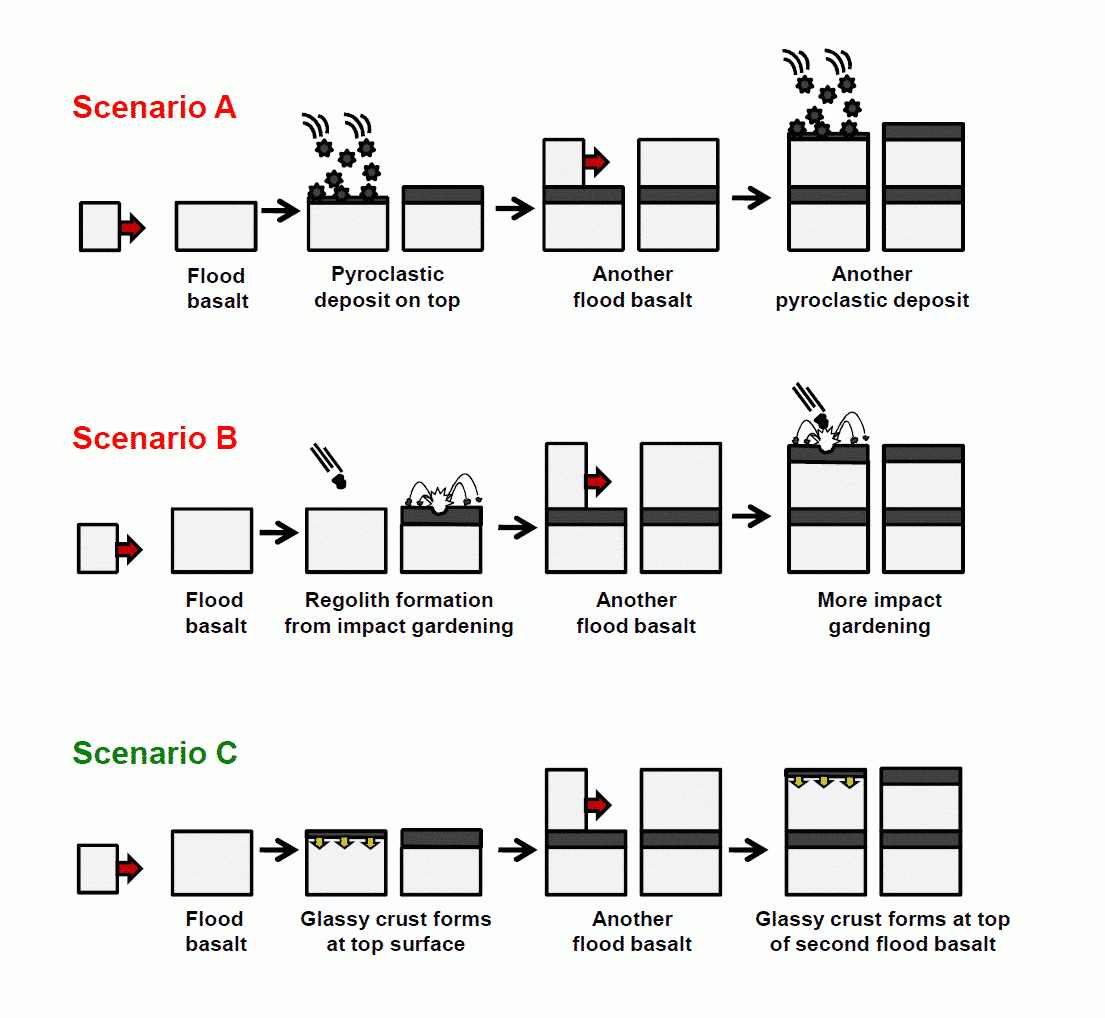
In their presentation, the authors preferred Scenario C as the best explanation. Scenario A requires a perfectly-timed alternating sequence of flood basalts and pyroclastic deposits, while Scenario B requires a much higher rate of regolith buildup between flood events than currently accepted (the estimated rate of lunar regolith formation is 1.2 meters per billion years). Scenario C only requires a sequence of bright material flood basalts oozing across the lunar surface; the dark glassy layer is naturally created as part of the flood basalt exposure process. The really nice part about Scenario C is that it also explains why the bright layer thickness can vary (different thicknesses of flood basalt) while the dark layer remains consistently the same thin band width (roughly the same thickness of rapidly-cooled glassy crust for each flood basalt flow).
So now we have a piece of the story of the pre-Aristarchus terrain. Each time the terrain was flooded by an outpouring of basalt, the top cooled quickly to form a glassy crust while the insulated flow underneath it cooled more slowly, a sequence that repeated over and over. The Aristarchus impact tossed out the large blocks that revealed the pre-impact layer stack.
So why do we only see these layered blocks at Aristarchus? The authors explain that to identify layered blocks, there needs to be a combination of three factors: image resolutions better than 50 centimeters per pixel (achieved only by Lunar Reconnaissance Orbiter and, in a select few places, by Apollo), a low sun angle, and a block size that is thicker than four or five of these layers, so that the multiple bright/dark layers can be identified. According to Mike Zanetti, when the same blocks at Aristarchus are observed at 1.5-meter resolution, the layered blocks cannot be positively identified. Also, at higher sun angles, the two terrains are bright enough to saturate the camera and wash out the details of the layers. As imaging continues and the LROC dataset is examined by more and more people, perhaps new examples of layered blocks will be discovered. If the stratified blocks are well-distributed around Oceanus Procellarum, it may help narrow down the formation hypotheses for lunar maria. (For those involved in the citizen science project Moon Zoo, there is a dedicated forum thread for the Stripy Boulder Hunt.) Each new identification will help build a more complete geologic story of our Moon.
Protect Our Shared Future
You help us defend humanity and prevent asteroid impacts. Donate now to become a Planetary Defender!
Donate