

 Explore Worlds
 Find Life
 Defend Earth

A few Mars Express Phobos goodies

Written by
Emily Lakdawalla
November 26, 2010
To celebrate Mars Express' recent mission extension to 2014, here are some cool pictures that it took of Mars' inner and larger moon Phobos. They were part of the most recent chunk of data released from ESA's Mars orbiter, an event I wouldn't have known about if it weren't for the ever-vigilant eyes of the unmannedspaceflight.com community (specifically, in this case, Peter Masek). Peter found a couple of lovely pictures of the dark lump of Phobos passing in front of Mars' limb:

At about the same time that that photo was taken, the super-resolution channel of the same camera snapped a series of frames of Phobos moving past its field of view:

There should be a lot of Phobos images in this and any subsequent data releases, because, since Phoenix landed, a major mission of Mars Express has been to observe and map Phobos, to lay the groundwork for the Phobos-Grunt sample return mission.
These two sets of images help to illustrate the difference between a "pushbroom" camera like the High-Resolution Stereo Camera and a "framing" camera like the Super-Resolution Channel. Framing camera images are snapshots from home digital cameras; you get a single field of view and a single moment in time. The SRC snapped five pictures in quick succession, during which time Mars didn't move very much within its field of view, but Phobos passed by more rapidly. Pushbroom cameras take one line of an image at a time, usually allowing the spacecraft's orbital motion to carry it one line's distance across a planet before recording the next line. As a result, single rows of pixels in pushbroom camera images represent instants in time, but the next row was taken at a different time. When there are two independently moving things in a pushbroom camera's field of view as an image is being taken, the camera usually tracks one of those things, which results in the other thing being distorted. In this case, it was tracking Phobos, while Mars, in the background, was distorted. You can see the same distortion with time in the HiRISE image of Phoenix descending toward its landing.
Here's another HRSC image of Mars containing two different targets. In this case, it's not Mars and Phobos; it's Mars and Phobos' shadow. Phobos' shadow is elongated in part because it's being cast in a glancing way across the surface of Mars. But its shape also must reflect the fact that the shadow was moving rapidly from west to east across' Mars surface even as HRSC was scanning, line after line, from north to south (or maybe south to north; I don't know whether Mars Express was on the ascending or descending leg of its orbit when this image was taken).
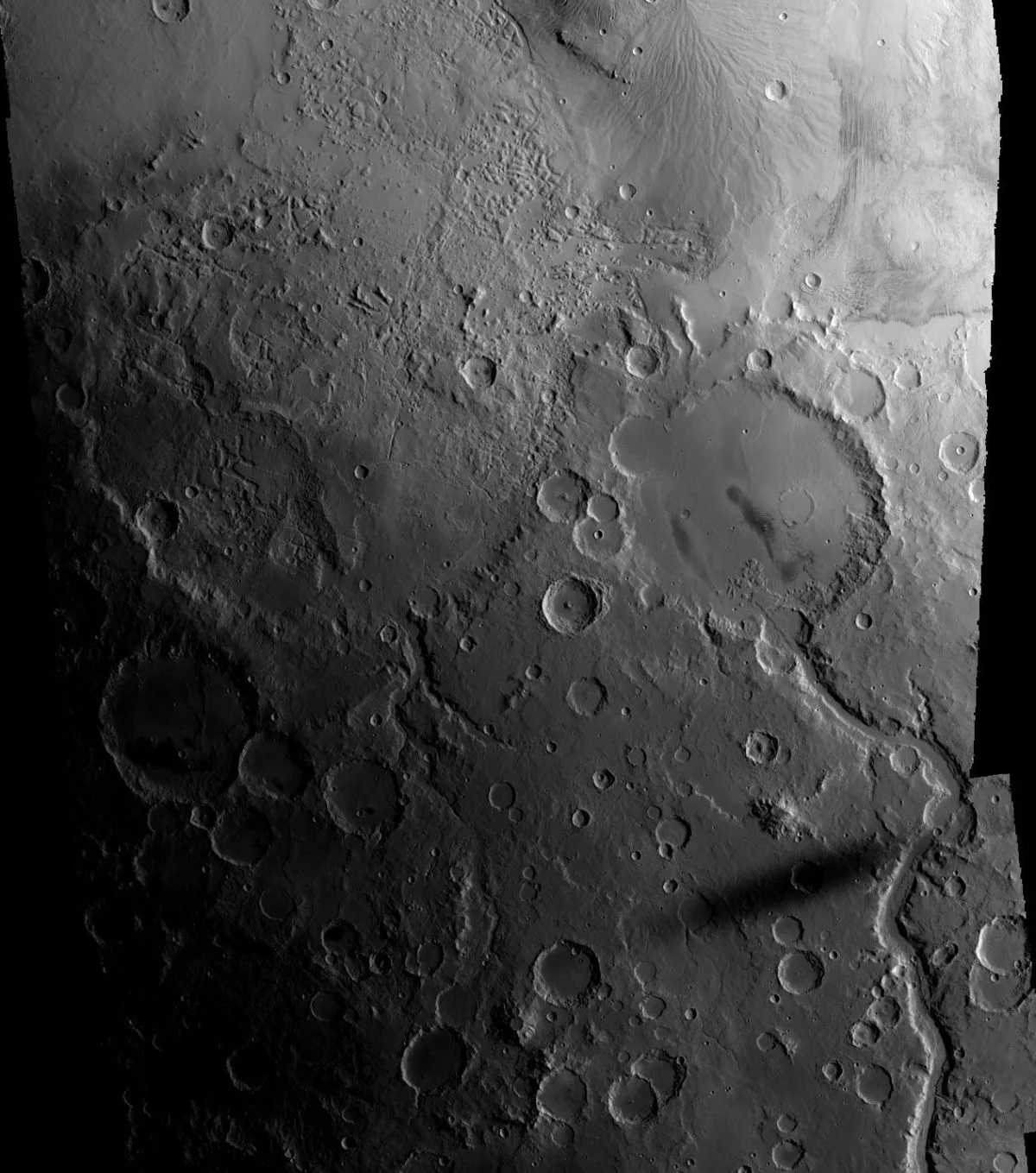
This image is also cool because it shows Gusev crater, Spirit's landing site. C'mon Spirit, wake up! The image also contains "my" volcano on Mars, Zephyria Tholus (the subject of the my single ever peer-reviewed paper).
You Power the Next Great Discovery!
Fund future scientific research that advances space science and exploration with your gift today.
Donate