

 Explore Worlds
 Find Life
 Defend Earth


Venus: Not so neat and tidy as we thought

Written by
Emily Lakdawalla
September 23, 2010
When Pioneer Venus visited our sister planet in 1979, it found an atmospheric feature called a "dipole" near Venus' north pole -- a pair of eddies swirling and rotating around each other as Venus rotated. When ESA's Venus Express arrived in 2006, it observed the same sort of thing at Venus' south pole, and scientists wrote a lot about how Venus was symmetric from north to south and how the polar dipoles were atmospheric features that were stable over decades. Here's one of those photos from 2006:

Except that it turns out it's not stable! Venus Express has been there for more than four years now, and as it's kept watching Venus' swirling atmospheric patterns, that "stable" southern dipole turned out not to be stable. At all. In a press release issued today, Venus scientist Giuseppi Piccioni remarks that the original observation of the southern dipole by Venus Express was "just a coincidence...the dipole in reality is not a stable feature on Venus, but just one shape among others."

The press release included several other cool images and animations. This one was my favorite.
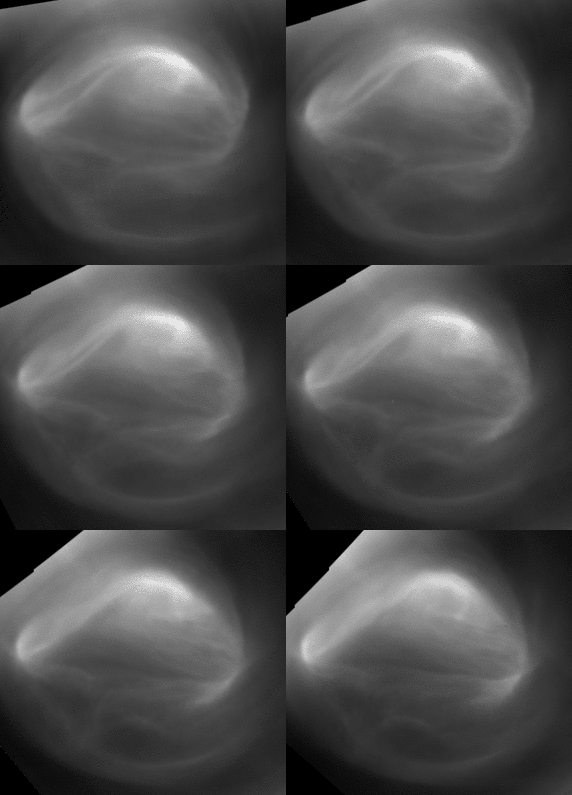
Venus' southern vortex A movie of the complicated swirling motions of Venus' south polar vortex as seen at a near-infrared wavelength of 3.8 microns, acquired by the Venus Express VIRTIS camera. The set of images show the temperature of the clouds' top. Darker regions correspond to higher temperature and thus lower altitude. The temperature contrast leads to an apparent three-dimensional effect of the images.Video: ESA / VIRTIS / INAF-IASF / Obs. de Paris-LESIA
Because I just can't get enough of animations, here is one more. These are cool because in each of them the frames have been rotated to take out the overall rotational motion of the vortex. What's left is the dynamics of clouds within the vortex, which are mesmerizing.
This release is just one of many coming out of the European Planetary Science Congress (EPSC) meeting this week, and I do not have time to get to them all. All of the press releases are rounded up here, including news about Mercury's comet-like tail, Martian methane, water on the Moon, and Phobos' possible impact origin. Of course, there are huge numbers of scientific presentations going on that are not being announced via press releases, but you can browse the program and all the associated abstracts yourself on the EPSC website.
You Power the Next Great Discovery!
Fund future scientific research that advances space science and exploration with your gift today.
Donate