

 Explore Worlds
 Find Life
 Defend Earth


Planetary Society Advent Calendar for December 14: The Moon

Written by
Emily Lakdawalla
December 14, 2009
The Moon is the most familiar of the objects in the heavens. So it's kind of incredible to think about the fact that humans had never seen half of it until just fifty years ago, on October 7, 1959, when the Soviet Luna-3 returned the first images of its far side. Like nearly every moon in the solar system, our Moon rotates at precisely the same angular rate that it revolves around the Earth; this "spin-orbit resonance" keeps the same face turned toward Earth at all times, with small apparent wobbles back and forth due to the Moon's orbit being elliptical.
Unlike the never-before-seen-by-spacecraft half of Mercury that I posted on December 4, the never-before-seen-at-all half of the Moon looked starkly different from the side we already knew. There were virtually none of the dark volcanic lava flows that make up the familiar nearside lunar "seas" or maria. Scientists are still struggling to understand why the far side is so different from the near side. The far side appears to have thicker crust, which may have inhibited the rise of the magmas that poured out to solidify and become mare; but why is the crust thicker there?

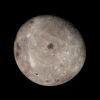
This unusual view of the lunar farside comes from an unusual source, Japan's Nozomi spacecraft, which was originally planned to reach Mars orbit in 1999. Unfortunately there was a malfunction during a critical engine burn necessary to send it on its way to Mars from Earth, and it entered solar orbit instead. After years of heroic effort and creative trajectory design, Nozomi was crippled by damage from a solar flare. JAXA did manage to navigate it to Mars, but it was unable to enter orbit, flying past it six years ago today, on December 14, 2003. According to Wikipedia, the spacecraft is still active.
I contacted someone I knew at JAXA about any other Nozomi images being made available, but if I understood the answer correctly, there aren't any plans to post the full catalog of Nozomi images online. Here's the one Web resource with Nozomi Mars Imaging Camera (MIC) images of the Moon and Mars (which unfortunately seems to be down at the moment I'm posting this!)
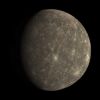
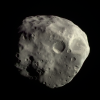
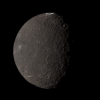
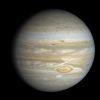
Each day in December I'm posting a new global shot of a solar system body, processed by an amateur. Go to the blog homepage to open the most recent door in the planetary advent calendar!
You Power the Next Great Discovery!
Fund future scientific research that advances space science and exploration with your gift today.
Donate