

 Explore Worlds
 Find Life
 Defend Earth


The Planetary Report • January/February 2001
Evolving Visions
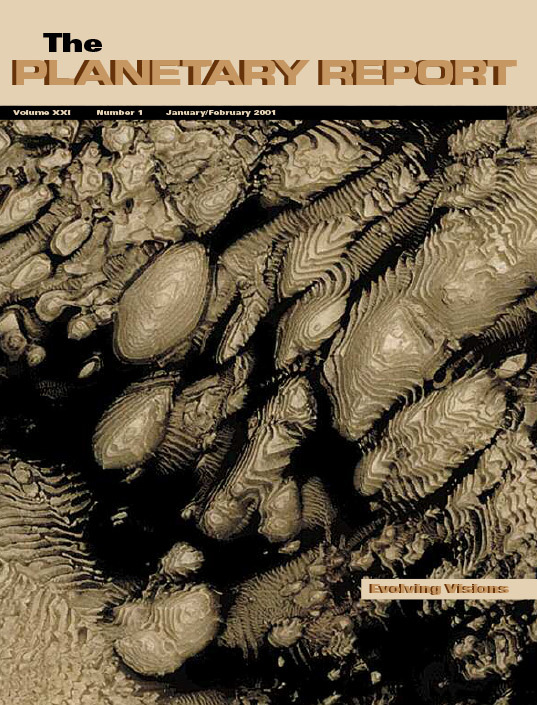
On the Cover: The plucky Mars Global Surveyor's Mars Orbiter Camera (MOC) zoomed in to get a closer look at erosion processes exposing hundreds of layers of similar thickness, texture, and pattern in an impact crater 64 kilometers (40 miles) wide in western Arabia Terra. In this MOC image, dark, windblown sand enhances the appearance of the layers. These layers provide a record of repeated, episodic changes that took place sometime in the Martian past. Layers toward the center of the crater are nearly horizontal, but those closer to or draping over the crater walls are tilted toward the basin center. Such relationships suggest the sediments creating these layers were deposited from above -- perhaps settling out of the Martian atmosphere or else out of water that might have occupied the crater as a lake.
Features
4 Opinion: Systems Engineering—A Personal Memoir: James D. Burke ruminates on the lessons to be learned in the wake of several spacecraft losses.
6 Odd Asteroids and Closet Comets: The Distinction Blurs: Don Yeomans talks about how our definitions of small objects in our solar system may need substantial reworking.
12 The Express to Mars: Robert Burnham takes a look at the plans for Europe's first mission to the Red Planet.
18 Hunting the Elusive "Wow": Robert Gray presents the results of The Planetary Society's efforts to redetect SETI's "Wow" signal.
Departments
3 Members' Dialogue Don't mess with Mars; patience and perseverance
17 World Watch Dim future for a Pluto mission; NASA advisory councils.
20 Q&A What is the asteroid belt? What color is the Moon?
22 Society News Red Rover, Shoemaker NEO grant winners, and the International Space Art Content

The Planetary Report • January/February 2001
Help advance space science and exploration! Become a member of The Planetary Society and you'll receive the full PDF and print versions of The Planetary Report.