

 Explore Worlds
 Find Life
 Defend Earth


More Solar Eclipses Viewed from Moons

Written by
Anne Verbiscer
July 11, 2009
by Anne Verbiscer
Central to the Enigma of Enceladus are the fantastic plumes of water vapor and ice that emanate from the "tiger stripe" fractures, or sulci, at the moon's south pole.
Interestingly, the plumes have yet to be seen by Cassini's Imaging Science Subsystem (ISS) cameras under anything but a fairly limited viewing geometry, specifically large angles between the spacecraft and Sun seen from Enceladus.
Observations at multiple viewing geometries allow planetary scientists to determine physical characteristics of plume particles.
The existence of the plumes was confirmed by Cassini's ISS in images obtained at high solar phase angles, or as they were viewed nearly backlit by the Sun. (The solar phase angle is the angle formed between Enceladus, the Sun, and Cassini.) Usually, Cassini cannot aim its cameras within 15 degrees of the Sun, which limits the phase angle at which the plumes (or anything else) can be viewed to 165 degrees or less. If the spacecraft is safely in eclipse behind Saturn, however, then higher phase angles are attainable. Cassini was in fact in eclipse behind Saturn, when it captured the spectacular 'Ghostly Fingers of Enceladus' image below at a phase angle of about 175 degrees.
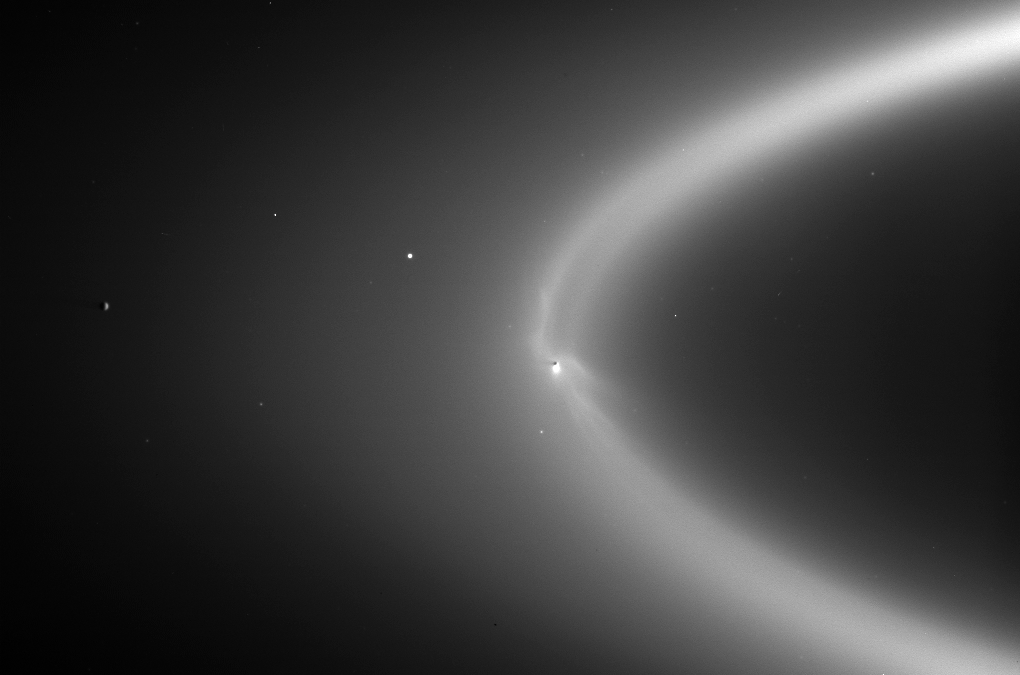
NASA / JPL / SSI
Ghostly Fingers of Encleadus
But what do the plumes look like at smaller phase angles? The smallest phase angle at which any plume images have been successfully acquired is about 140 degrees, as shown in the figure below.
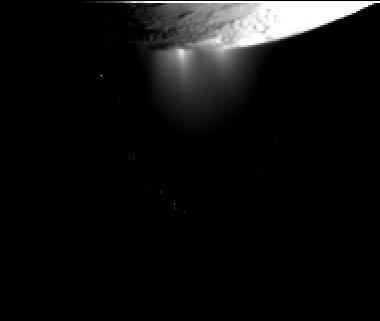
Plume from Enceladus
ets emanate from Enceladus' south pole as the surface is illuminated by Saturnshine.
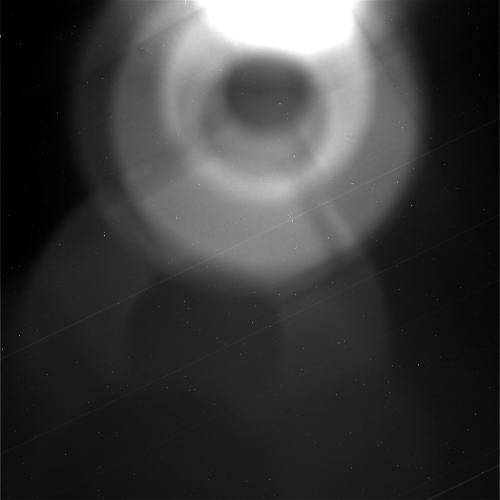
Hiding Plumes
nternal reflections hide Enceladus' plumes from view at low phase angles.
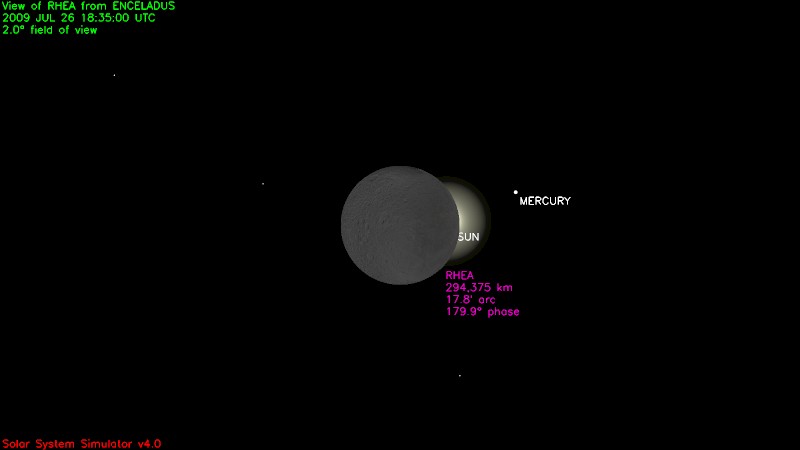
Getting Some Help from Rhea
total solar eclipse by Rhea, viewed from Enceladus.
 Anne Verbiscer is a Research Associate Professor at the University of Virginia. She studies the surfaces of icy bodies in the outer Solar System and has been involved with the Cassini mission to Saturn since 2007. Currently a visitor at Southwest Research Institute, she has been enjoying the past year living in the mountains above Boulder, Colorado.
Protect Our Shared Future
You help us defend humanity and prevent asteroid impacts. Donate now to become a Planetary Defender!
Donate