

 Explore Worlds
 Find Life
 Defend Earth


A forgotten image of Earth and the Moon

Written by
Emily Lakdawalla
February 13, 2013
I was digging into ESA's Rosetta mission archives and stumbled upon an image I don't remember seeing before, from Rosetta's first Earth flyby. It's striking how dark the Moon is. The Moon is considerably darker than Earth (or at least Earth's clouds) to begin with; and we appear to be looking at Procellarum here, so it's a particularly dark bit of the Moon. The image as posted on the ESA website was pretty raw, so I did a little work on it. Just imagine arriving from out of deep space and careening past Earth, seeing the Moon swing suddenly above the horizon and then, minutes later, watching everything recede into blackness again.

I checked ESA's Planetary Science Archive and there's lots of other navigational camera data from the Earth flybys though I think it's pretty safe to say that this is the most awesome image from the first flyby. The rest showed at most one world. This one is twice as nice because it contains two!
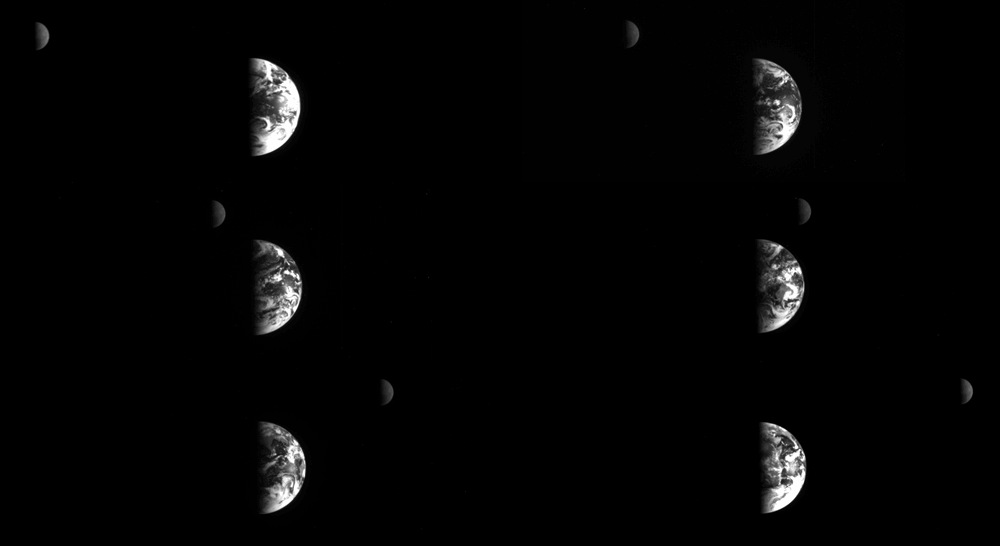
This photo reminded me that I have more work to do to import images from our old website. I used to have a great collection of photos from Earth taken by interplanetary spacecraft, and I'm working to reassemble it. Here's a particularly cool series taken by Galileo as it departed from its second Earth flyby -- the last time it would ever be close enough to Earth to achieve high enough data transmission rates to be able to relay movie frames. I like watching the shiny specular reflection of the Sun off of Earth's oceans, how it stays motionless while Earth rotates under it, and how it flickers brighter and dimmer as it crosses water and land.
You Power the Next Great Discovery!
Fund future scientific research that advances space science and exploration with your gift today.
Donate