

 Explore Worlds
 Find Life
 Defend Earth


"False-tonal recording?" The sounds of a coronal mass ejection

Written by
Emily Lakdawalla
March 15, 2012
Humans are visual creatures. When we have data that doesn't come from devices sensing the world in wavelengths of the electromagnetic spectrum that match the narrow band that human eyes can detect, we usually try to manipulate the data in such a way that we can "see" it. With cameras sensitive to wavelengths of infrared light, for instance, we make false-color images, showing variations in color that are not "real" in the sense that they match what we would see, but they are very "real" in the sense that the variations have a direct relationship to actual variations of physical properties from place to place. We turn topographic data into colorful images (often, red or yellow = high and blue = low), or encode all sorts of other data in ways that allow us to draw on our powerful visual-spatial processing skills to see patterns and relationships within the data.
We use our other senses for data analysis less often. It's hard to encode data in a way that we can make use of our senses of touch, taste, or smell. But while we're certainly not the best in the animal kingdom, we have pretty good senses of hearing, and there are some kinds of data that make a lot of sense when encoded that way -- data having to do with frequencies or energies, like radio or seismic waves or charged particles. In audio, unlike with images, how the data vary as time goes on is of paramount importance; and we can hear numerous different pitches at the same time, where it can be hard to make sense of that same scatter of color at one spot in an image. Instead of false-color images, are these false-tonal recordings?
Anyway, the reason I talk about this is because of a new "sonification" of the recent solar storm by Robert Alexander (a University of Michigan graduate student), employing data from the MESSENGER and SOHO spacecraft. I'm not saying that the sonification is a superior way to analyze the data. It's just a way of drawing on a different, additional part of our own human processing power to understand what a data set is telling us.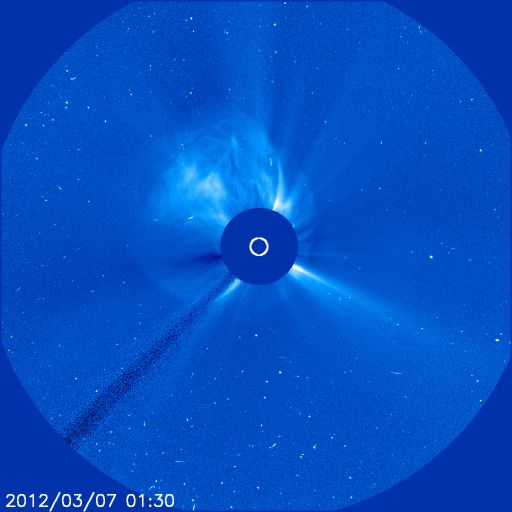
You Power the Next Great Discovery!
Fund future scientific research that advances space science and exploration with your gift today.
Donate