

 Explore Worlds
 Find Life
 Defend Earth


Iapetus' peerless equatorial ridge

Written by
Emily Lakdawalla
February 22, 2012
Whenever I want to find something new and different to write about, it's easy to find good ideas: just go to the website of a scientific journal and look at their current table of contents or papers in press. I checked out the Journal of Geophysical Research - Planets yesterday, and found a new paper in press by Dombard, Cheng, McKinnon, and Kay that claims to explain how Iapetus' equatorial ridge formed. Cool!
First, let me set the stage. Iapetus is bizarre in a lot of ways. It has a yin-yang surface of dark and bright material. It is unexpectedly flat pole-to-pole. It seems to have an excessive number of large impact basins. And it has a mountainous ridge, up to 20 kilometers tall, running exactlyalong its equator for well over three-quarters of its entire circumference. The existence of this ridge was revealed very early in the Cassini mission, in an encounter at the end of 2004.

But Cassini got much better views of the ridge later, during its one and only close flyby of Iapetus. Here's one of those views. You can really see how Iapetus' disk has a fairly smoothly round shape that's interrupted, right at the equator, by a long ridge that is essentially triangular in cross-section (though battered by impacts).

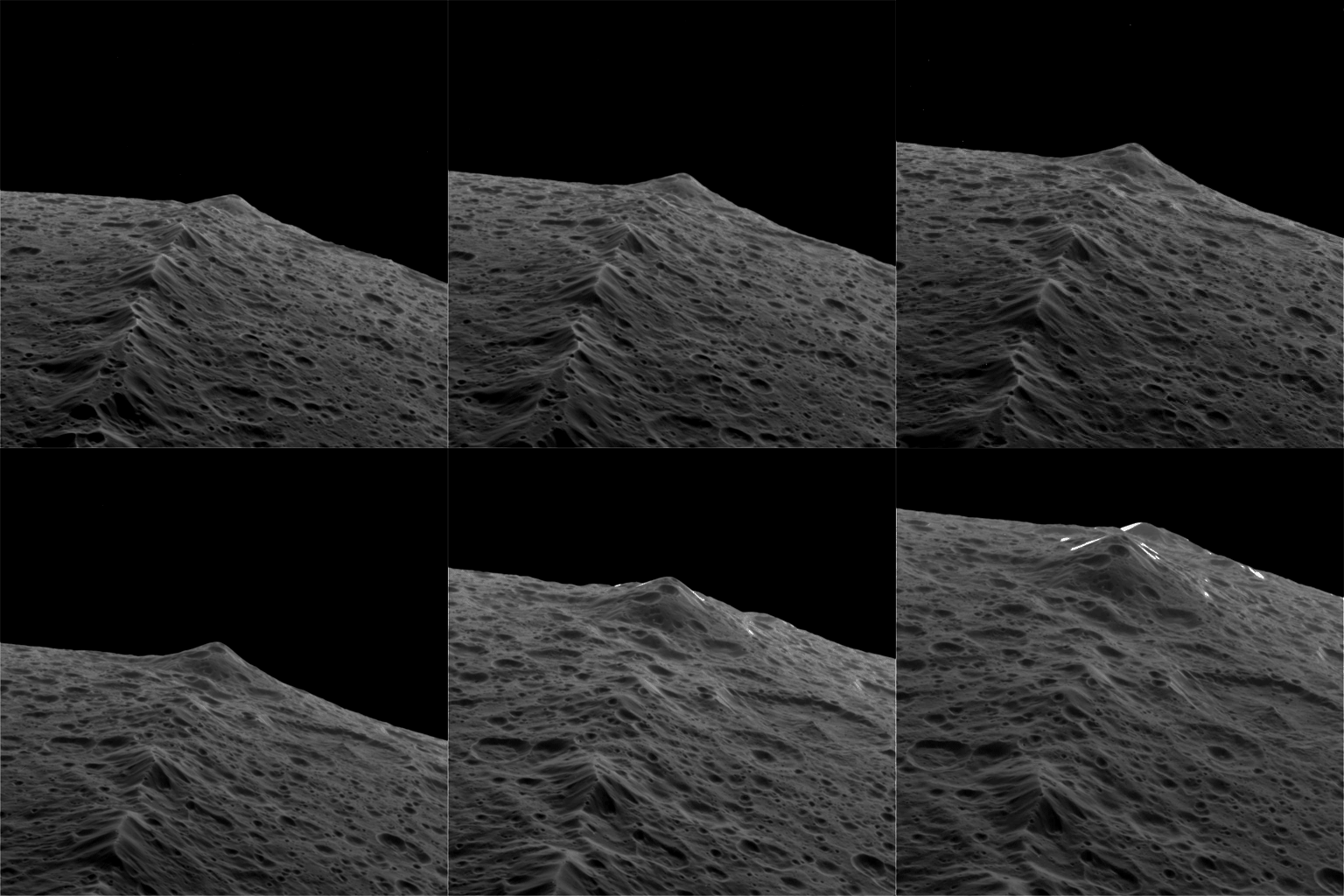
The ridge is mostly seen on the dark, leading hemisphere, breaking up a bit on the trailing hemisphere. In this wonderful image sequence, Cassini sights across the limb as it flies past, and you can see the relatively bright white slopes of trailing hemisphere material come into view toward the end.
Before Dombard and his coauthors can explain how the ridge formed, they begin by explaining what it is. Here are the salient features of Iapetus:
- It is equatorially flattened by 4.5%, meaning that it's about 70 kilometers shorter pole-to-pole than it is wide across the equator. (For comparison, Earth's rotational flattening is only 0.3%.) This amount of equatorial flattening would make sense if Iapetus had a day only 16.5 hours long, but its days are actually 79 Earth days long.
- The equatorial ridge is up to 20 kilometers high, 200 kilometers wide, and spans more than 75% of Iapetus' equator. If you do the math, you'll find it contains 0.1% of all of Iapetus' mass. This is both a little and a lot. All of Earth's oceanic crust amounts to 0.1% of Earth's mass.
- It is perfectly straight and sits exactly on the equator.
- It is heavily cratered, so appears ancient.
- Iapetus doesn't have any other major geomorphic features other than the ridge and lots of craters.
- The ridge is "supported by the lithosphere without an obvious flexural signal." Don't worry, I'll explain.
This last observation is really important, so I'll explain what it means. It has to do with something called isostasy. The planets and moons of the solar system all have solid outer crusts, which seem firm and unbending. In fact, though, solid worlds flex and bend all the time. On Earth, it's quite a common thing to have mountains appear suddenly (in terms of geologic time, that is). Mountains are heavy, and their weight exerts a very strong force on the rock beneath them. The rock of Earth's mantle flows out of the way of this pressure (flowing in the solid state, over geologic time), and the stiffer rock of Earth's crust bends downward beneath the load of the mountain. So, wherever you have big, suddenly created mountains, like volcanoes, there's usually a flexural moat around them, an area where the crust is depressed by the weight of the mountain. Of course, on Earth, such moats are rapidly filled by sediment, so they don't show up in topographic surveys, but the moats are very easy to see in gravity survey data.
Back to Iapetus: it's very surprising that a ridge so massive, so tall, and so narrow doesn't have a flexural trough running down each side of it. What that means is that the ridge formed at a time when Iapetus was so cold and stiff that the moon's crust has been strong enough to support the weight of that ridge without bending at all ever since the ridge formed. The first part of the paper explores exactly how cold Iapetus has needed to be since the ridge formed. The answer is very cold; specifically, it can have been putting out heat energy amounting to no more than 3 milliwatts per square meter since the ridge formed. This means that the ridge must have formed after all of Iapetus' primordial heat had pretty much dissipated. Current models for Iapetus' formation don't get this cold until about a billion years after the moon itself formed. The ridge formed relatively late in Iapetus' history.
So, any idea for how the ridge formed must explain the following things. The ridge:
- formed late;
- sits exactly on the equator;
- is found only on the equator (that is, there are no other ridges on Iapetus); and
- is found only on Iapetus.
Next, Dombard et al. go through the mechanisms that have been proposed so far to explain the ridge's formation. This part of the paper depends strongly on observations of other moons across the solar system, all of which are made of the same materials under the same laws of physics, but whose histories have diverged to show us how different conditions can affect the same materials.
Some people have suggested that the ridge resulted from Iapetus' despinning (going from a 16.5-hour to 79-day day). But these can't explain why a ridge formed only on the equator, and not also in other places, like the tectonic features found all over Europa and Ganymede (and predicted to be observed on Pluto and Charon). Another suggestion is that it formed by some kind of push up from below; but this would require Iapetus' stiff outer layer to be relatively thin, so there should be a flexural moat,and there isn't. Another idea is that Iapetus was spinning so fast when it formed that it was near its rotational stability limit, and the equator was raised because the centrifugal force nearly counteracted gravity. But a body as large as Iapetus wouldn't be able to maintain a circular equator under such conditions; it would become a football shape, like Haumea and possibly Varuna.
The only remaining possibility is that the ridge actually started out as a debris ring, which collapsed onto Iapetus. Now, I must admit that I, personally, have always been hostile to this idea, because it's counterintuitive to me that you can build an edifice by crashing stuff in to a moon. Dombard and his coauthors don't seem to regard this as a problem, and neither do Wing Ip or Hal Levison, who have both written papers on the topic.
However, Dombard et al. point out that if this really is how Iapetus' ridge formed, then it's hard to explain why we see the ridge only on Iapetus and not on any other moon in the solar system. How can Iapetus be so unique?
So here's the last part of the paper: they tell a fairy tale about how the ridge formed, then poke at the fairy tale to see how the story would be different on other moons. Here's the fairy tale: As Iapetus was forming, very far from Saturn, it either captured a 100-kilometer-diameter satellite or suffered a giant impact whose debris coalesced into a satellite of that size. At Iapetus' orbital distance from Saturn, impacts between Iapetus and anything in a similar orbit would be very slow, well under a kilometer per second, so it's actually very easy to imagine Iapetus capturing a body of this size.
Initially, Iapetus' moon would have had a very elliptical orbit, but tidal forces would circularize the orbit. Then, the orbit would evolve, either going closer to Iapetus or farther away from Iapetus with time. If it started out on a retrograde orbit; it would get closer; if on a prograde orbit, it would get farther. At this point in the paper they do a little physics and show that for pretty much any prograde orbit, the moon would eventually recede to about 9 times Iapetus' diameter away from the moon.
All this time, though, Saturn is exerting its own tidal forces on Iapetus, causing the moon to slow from its initially fast rotation to its present very slow rotation. This takes a while, possibly billlions of years. But once Iapetus is spinning so slowly, it acts as a brake on the little satellite's outward travel. The orbit starts to move closer and closer to Iapetus, rather rapidly.
Soon the satellite is so close to Iapetus that it's within the Roche limit, where Iapetus' gravity tears apart the satellite (which was most likely a rubble pile to begin with). A thick debris ring forms. Crashes among debris pieces make them smaller and also flatten the ring until, like Saturn's ring system, Iapetus' ring system is perfectly flat and perfectly aligned with its spin equator. Over time, the bits of moon de-orbit, one by one, striking Iapetus at very glancing impact angles and at very low speeds, under a hundred meters per second. These speeds are so low that they would build up rather than tear down the surface.

This art shows Rhea, not Iapetus, but the idea is the same.
This is a nice story, a plausible one, backed up by physics, and it handily explains why the ridge is perfectly on the equator and only on the equator. Furthermore, since it must have happened after Iapetus had despun, it also would necessarily have happened at a time when Iapetus was stiff enough to support the ridge without any flexural moat. But it doesn't explain why this only seems to have happened on Iapetus. Why are there not fossil ring ridges on other moons?


(Theory says Oberon could, but if it does, it's not obvious in Voyager images.)
Again, Dombard et al. turn to physics. First, they ask which moons in the solar system are far enough from their planet that they have a large enough gravitational zone of influence to capture and then hang on to a satellite for long enough for it to make a ring. Because of Iapetus' uniquely far orbital distance (it's 3.5 million kilometers from Saturn, compared to 1.2 million for Titan, and 1.9 million for Callisto from Juputer), Iapetus has a lot more space within its gravitational influence than any other outer solar system moon. It controls about ten times as much space as Callisto, Titan, and Oberon, the next three most gravitationally influential moons. Most moons couldn't capture or keep a satellite at all, because they're too close to their giant planets, and not influential enough. That gives Iapetus much better odds of having captured and held a satellite to make a ridge from.
Still, it does seem reasonable that Callisto, Titan, Oberon, and potentially Ganymede and Titania could have captured satellites and turned them into ridges. Why don't these moons have them? The answer has to do with time. Again, going back to physics, Dombard et al. show that on all these other moons, ridges certainly could have formed. But remember that ridge formation is triggered by the despinning of the moon, which happens faster for moons that are closer to their planets. In fact, any ridges would have formed at ages of a few tens to a few hundred millions of years for all moons except two. Just a few hundred million years into the formation of the solar system, there was still extremely heavy bombardment going on (whether you believe in the Late Heavy Bombardment or not), so any ridge that formed would most likely -- though not certainly -- have been eroded completely away by impacts.
The only two moons whose ridges would have formed comfortably after the violent early days of the solar system are Iapetus and Oberon. I chuckled when I read this, because it's very convenient that their paper makes a prediction like that for a moon that is very poorly observed and very likely to remain so for quite some time. (We did see Oberon with Voyager, of course, but Uranus and all its moons were tipped pole-on to the Sun at the time, meaning that their equators were mostly not imaged.)
To be fair, though, they also make many other predictions that can be tested with future work. We need to simulate impacts onto Iapetus to see if it really could have captured debris into a satellite. We need to test what happens when many small, grazing, impacts at low speeds really do build a ridge rather than create craters. We need to look at Iapetus' cratering record to see if the ridge really is much younger than the rest of the moon (though this would be complicated by the fact that the ridge was built by impacts so may retain an anomalously large number of craters).
I want to close this lengthy post by complimenting the authors of the paper on their prose. It's a theory-laden paper with (horrors!) equations, but the verbs are active, the adjectives colorful, the arguments easy to parse. The title of this blog entry is an exemplary phrase from the paper. I wish more scientists wrote like this!
You Power the Next Great Discovery!
Fund future scientific research that advances space science and exploration with your gift today.
Donate