

 Explore Worlds
 Find Life
 Defend Earth


Six moons with one shot

Written by
Emily Lakdawalla
October 9, 2010
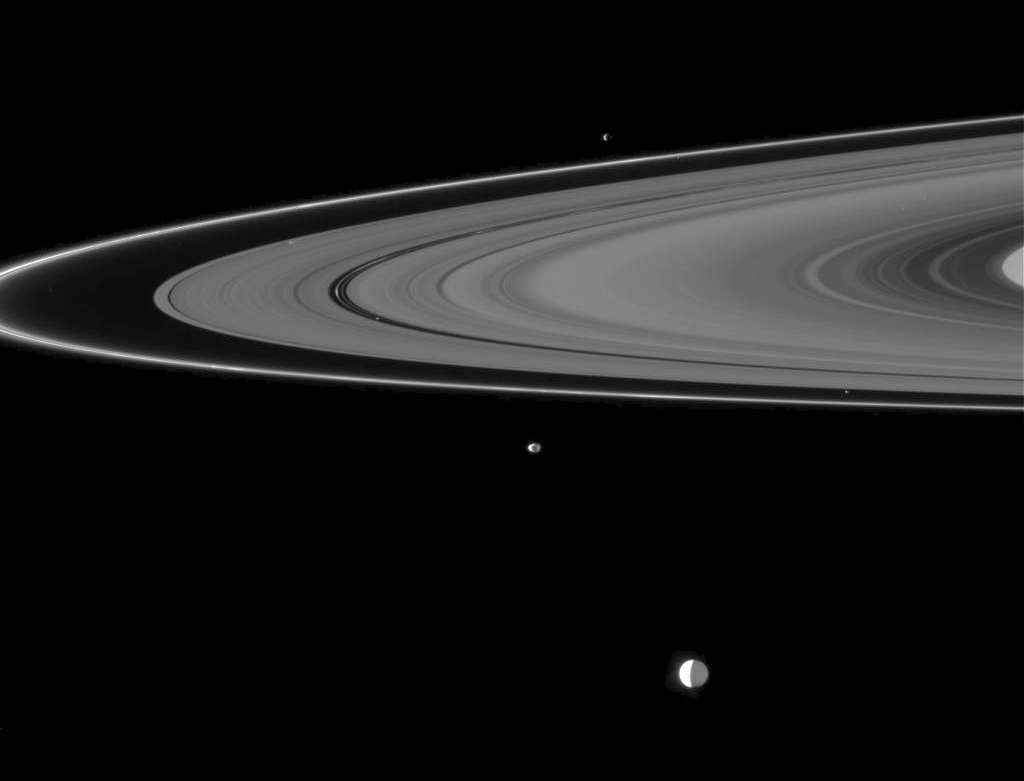
There are six, count them, six moons in this photo. Plus the outer edge of Saturn's rings. Awesome.
NASA / JPL / SSI
Six moons with one shot
On October 6, 2010, Cassini managed to catch six different moons passing through its narrow-angle camera field of view at once. At the time, Cassini was on the southern (shadowed) side of the rings, so the uppermost part of the rings are closest to Cassini, and rings and moons orbiting Saturn appear to be going in a clockwise direction. With the Sun behind and to the left of the rings as seen from Cassini, the skinny multiple braid of the F ring is the brightest of all the visible rings; its sparse, dusty material scatters light forward to Cassini like dust motes in a sunbeam. The largest moon visible, Enceladus, is the farthest away from Cassini. Both Enceladus and Janus, the oval-shaped moon above it, have night sides lit by light reflected from Saturn. To the right of both Enceladus and Janus, between the bright F ring and the main rings, is Atlas. Immediately above Janus, orbiting along with a pair of ringlets within the Encke gap, is Pan. (Pan appears to be accompanied by a clump in one ringlet.) Immediately above Pan is Daphnis, making a bright spot within the Keeler gap at the outermost edge of the main rings. Above the F ring near the upper right corner of the image is Epimetheus. Unlike Janus and Enceladus, Epimetheus is located between Cassini and Saturn, so its night side is not lit up by reflected Saturnshine.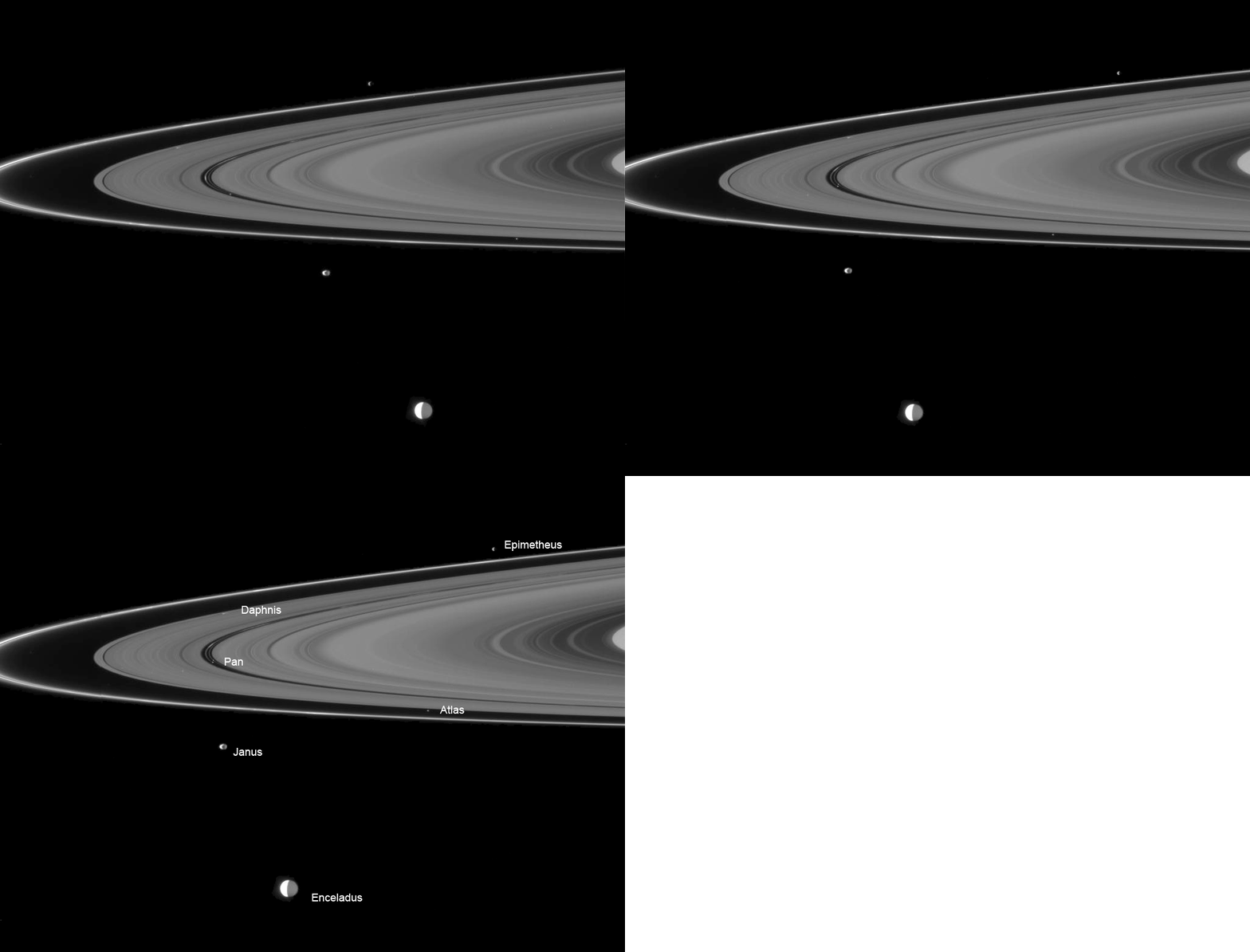
NASA / JPL / SSI / animation by Emily Lakdawalla
Six moons with one shot (animation)
Protect Our Shared Future
You help us defend humanity and prevent asteroid impacts. Donate now to become a Planetary Defender!
Donate