

 Explore Worlds
 Find Life
 Defend Earth


365 Days of Astronomy Podcast: The Flight of Hayabusa

Written by
Emily Lakdawalla
September 12, 2010
Today the 365 Days of Astronomy podcast aired my contribution, The Flight of Hayabusa, a 10-minute recap of that dramatic mission. Here's a link to the podcast, and following is the transcript. At the end of the podcast, I promise a video version that's not actually available -- I couldn't get the recording together. I hope you like it anyway!
Near midnight on June 13, 2010, the sky over the Australian outback was full of stars. Hundreds of people stood below that sky, having driven for hours through the barren Red Desert for a chance to witness the death of an interplanetary explorer. On schedule, at fourteen hundred hours UTC, a pinprick of light appeared in the sky.
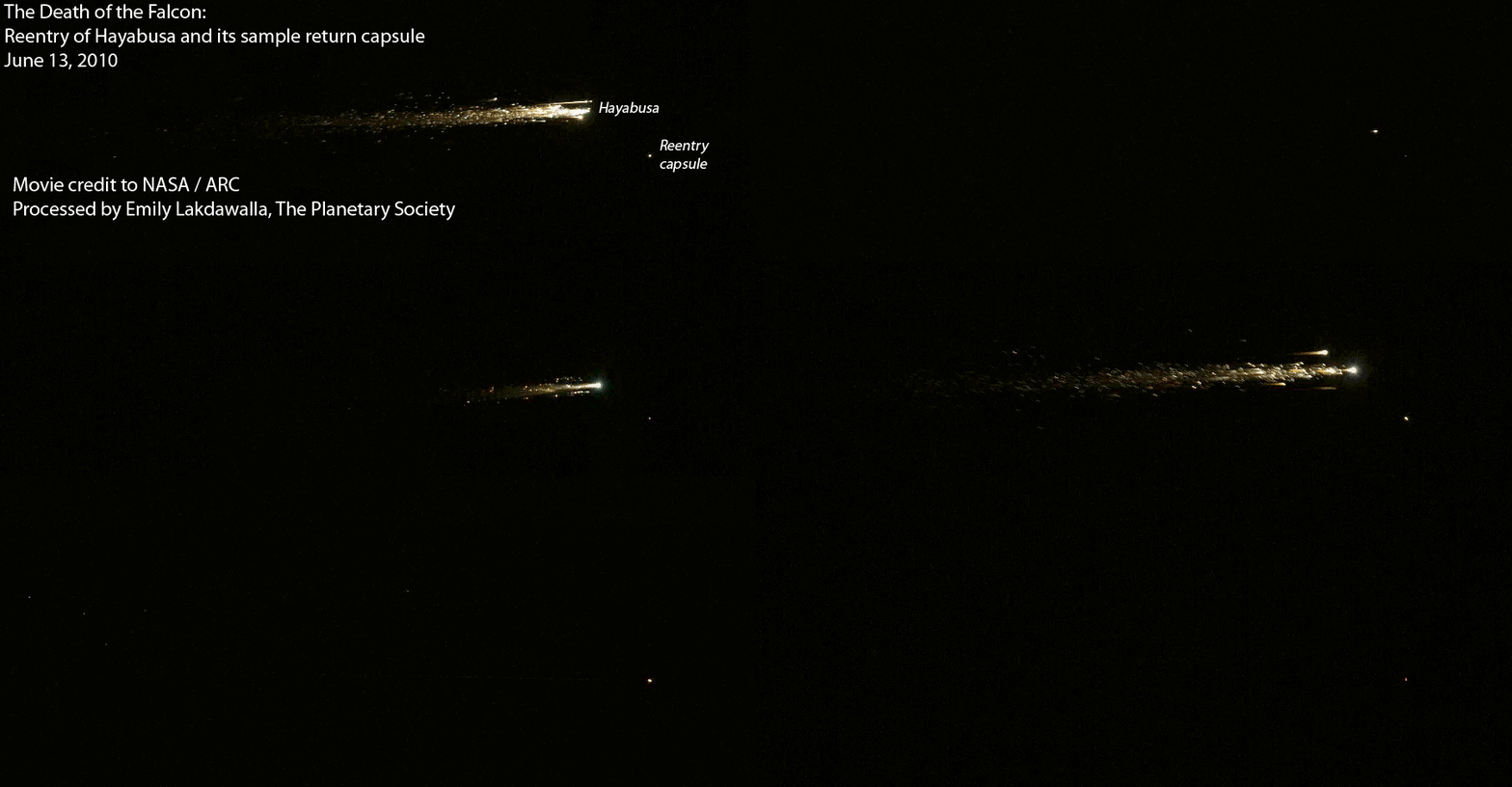
That pinprick burst into flaming brightness, sparkling as the spacecraft's solar panels, then radio dish, then maneuvering rockets, and finally central body exploded and then vaporized into nothingness. The brilliant light petered out, leaving behind only a smaller, glowing ember that still steadily arced across the sky.
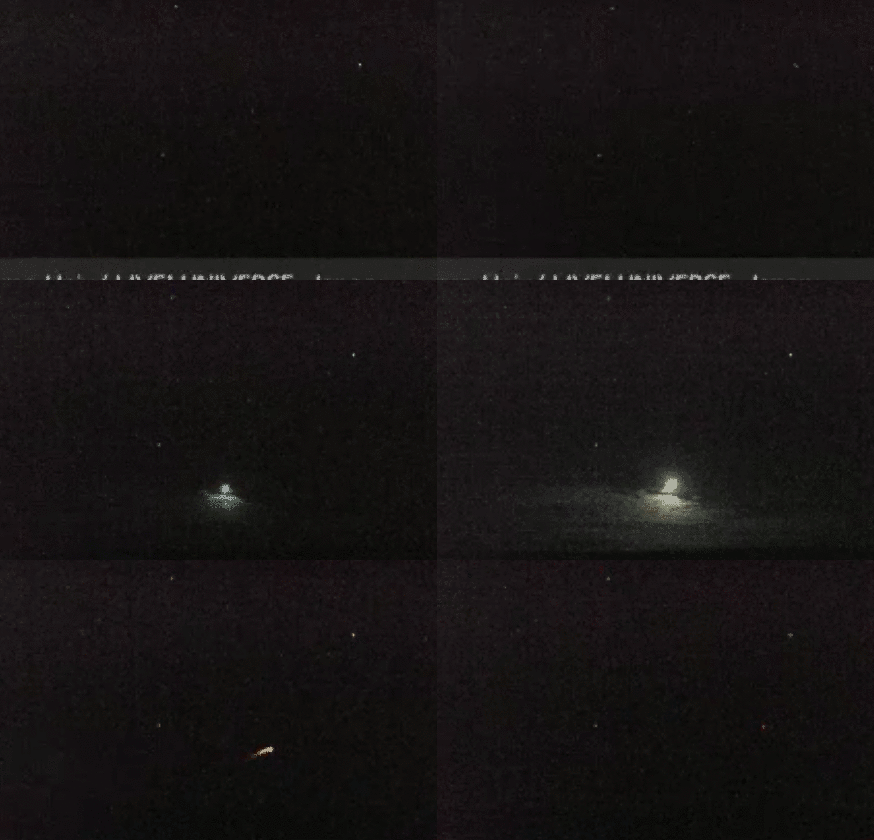
The dying spacecraft was named Hayabusa, Japanese for peregrine falcon. The still-glowing bit was Hayabusa's sample return capsule, which descended rapidly toward the desert until it opened a parachute and floated gently to ground. When the capsule was recovered the next morning, it looked as shiny and new as if it had never left Earth in the first place. You'd never guess that it had survived a seven-year journey, traveling more than a billion kilometers each way to a tiny, cold asteroid and back. And most people never expected the capsule to come home.
I'm Emily Lakdawalla, from The Planetary Society, and I've been following Hayabusa's amazing journey for The Planetary Society blog since it arrived at its target asteroid. But Hayabusa's story begins earlier than that, when the Japanese space agency conceived a daring mission that would return a sample from a tiny near-Earth asteroid, the sort that presents a hazard to life on Earth. The little solar-powered spacecraft was fitted with four gimbaled ion engines as its main thrust source -- the same sort of engines used on the Deep Space 1 and Dawn spacecraft. It had two redundant chemical thruster systems for maneuvering, and three reaction wheels to control the spacecraft's orientation in space. It had a sampling horn that would contact the asteroid, fire pellets at its surface to knock off asteroid dust, and enclose the dust in a sample-return capsule.

Hayabusa launched in May 2003 toward a tiny asteroid later named Itokawa for the man regarded as the father of Japanese rocket engineering. It ran into trouble almost immediately. Just six months later, the biggest solar flare in recorded history erupted from the Sun. The flare reduced the efficiency of Hayabusa's solar cells, which not only ran its electronics, but provided the power to its ion engines. The engines couldn't produce as much thrust as planned, so Hayabusa's arrival at the asteroid was delayed. On top of that, one of the four ion engines failed to work right. But the mission had been designed to succeed with only two engines, so Hayabusa carried on.
In May 2004, a year after launch, Hayabusa became the first spacecraft to perform a gravity-assist flyby using only ion engines, not chemical thrusters, when it revisited Earth to get a push out to Itokawa. As it approached Earth, one of its three reaction wheels failed, but Hayabusa only needed two wheels for its controllers to maintain its orientation in space. The mission kept going.

Four months later, Hayabusa spotted its destination, Itokawa, for the first time. It took another year, until September 2005, for Hayabusa to approach closely enough to resolve the asteroid's shape. The approach was challenging because Itokawa's gravity is so tiny as to be completely negligible. Hayabusa couldn't enter orbit around it; instead, it matched solar orbits with Itokawa, flying in formation with it around the Sun.
It was a real surprise to me when I first saw Hayabusa's images -- the shape of Itokawa reminded me of a Cheez Doodle, those puffy snacks that leave orange stains on your fingers. The Japanese are a little more poetical than I am, and saw a sea otter, floating on its back, with a scallop shell balanced on its chest by one paw. Regardless of what Itokawa reminds you of, it doesn't look anything like any other asteroid that's ever been visited before.
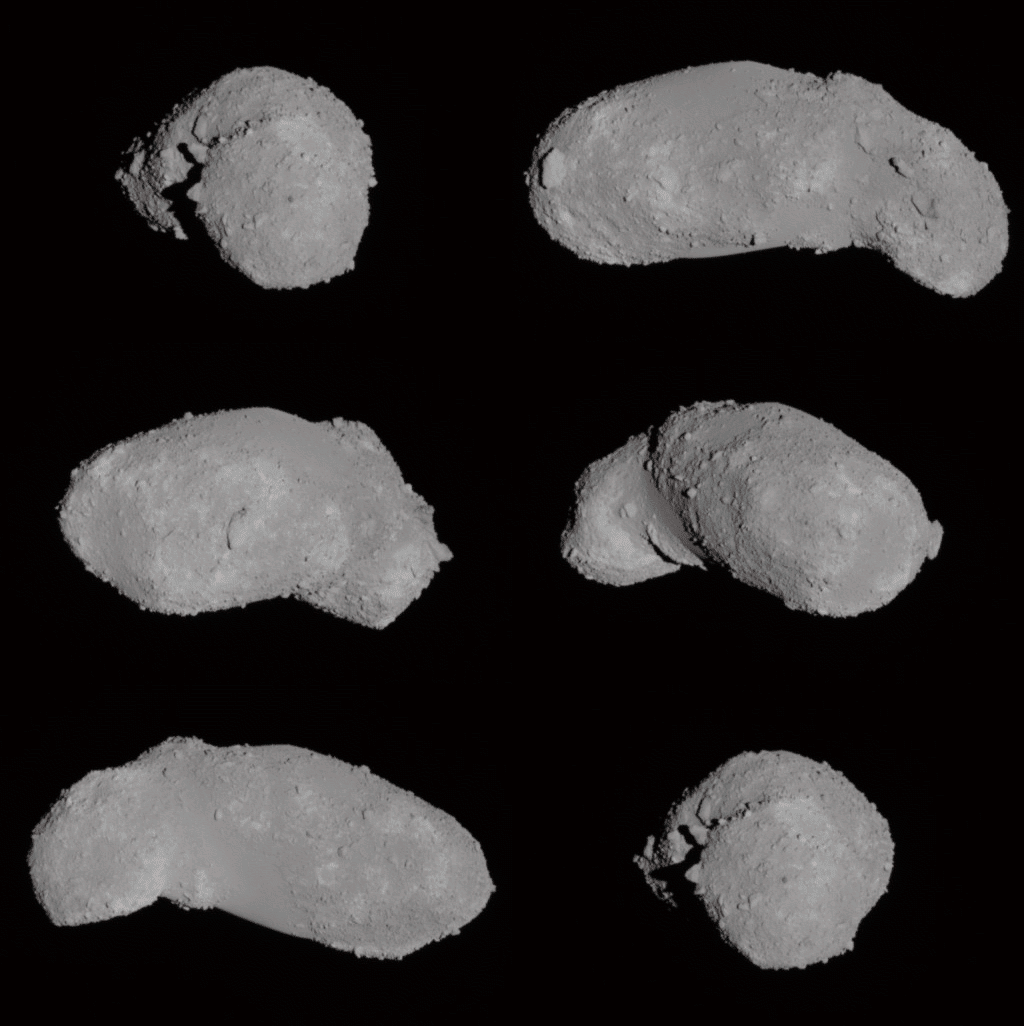
Hayabusa surveyed the asteroid, taking pictures of all sides of it, spotting large boulders and gravels covering most of it, interspersed with a few unusual smooth looking areas that the Japanese thought of as seas or bays. Sometimes Hayabusa's wanderings took it between the Sun and the asteroid, and the spacecraft cast a shadow on the surface; you could see the spacecraft's bus and two solar panels very clearly. The size of that shadow brought home to me the reality of just how small Itokawa is. At about five hundred meters long by two or three hundred meters across, it's just a couple of city blocks in size.
As Hayabusa approached Itokawa for a closer look, a second reaction wheel failed, leaving only one. That's not enough for control of the spacecraft's orientation, so engineers were forced to use the chemical thruster system to help with attitude control. Still, the survey continued and the spacecraft toured the whole asteroid, getting dramatically side-lit views and imaging both poles.
When the surveys were done, Hayabusa was commanded to approach to within three kilometers of Itokawa to prepare to grab a sample. The sample grab was nothing at all like a Mars or Moon landing. With Itokawa's negligible gravity, it was much more like the docking of two spacecraft in orbit. To help with the rendezvous, Hayabusa released a small metal ball, which landed on the asteroid. The ball would act as a laser reflector to guide Hayabusa's landing. It also carried nearly a million names collected by JAXA and the Planetary Society and is, presumably, still sitting where it landed.

Hayabusa's first landing attempt was on November 19, 2005. JAXA engineers were live blogging at the time, and there was a lot of confusion about what exactly happened that day. At first they thought it hovered just above the surface for half an hour; then they decided it had landed. Images showed a strange gravelly surface lacking dust, very different from the Moon. That was the good news. The bad news was that the spacecraft hadn't been designed to spend such a long period so close to the Sun-heated surface of the asteroid. The spacecraft overheated, went into safe mode, ascended rapidly to a distance of 100 kilometers, and began to spin.

Over the next few days, engineers regained control, spun the spacecraft back down, and brought it back to Itokawa for a second landing attempt. I didn't watch that attempt as closely as the first, because it was over the Thanksgiving holiday. At first it seemed it had gone very well and that the mission was a triumphant success.
But that first impression was wrong, really wrong. I think engineers still don't understand exactly what happened, and probably never will. They now know, at least, that as Hayabusa ascended from the asteroid, there was a leak in its chemical thruster system. That, and maybe other problems, caused the spacecraft to spin out of control again, and for several days Japan actually lost contact with it. Loss of contact often means the end of a mission -- those were very scary days.
Over the next weeks, they regained contact, but the situation remained very confusing. They couldn't stop the spacecraft from spinning, couldn't regain control. Even worse, the little sensible telemetry that they could get from the spacecraft indicated that their sample collection hadn't worked right; the pellets had failed to fire, so it was possible that the sample collector was empty.
The situation continued to be very, very bad for several weeks. Slowly, the Japanese learned about the damage that Hayabusa had suffered. Its chemical thruster system was completely lost. Four of its eleven battery cells were irreparably damaged by deep-space cold. They were down to one functioning reaction wheel. They lost more engines, leaving only one good ion thruster and one temperamental one. They ran out of time. They couldn't regain control of the spacecraft before the date that they had to depart Itokawa for Earth. Earth moves faster in its orbit than Itokawa does in its more distant one, and had run away from the asteroid. There was nothing to do but to delay Hayabusa's return to Earth by three years -- if it could return at all. But they still had contact, still had command. And, what's more important, they had patience, creativity, and the will to keep Hayabusa alive.
A year passed. The mission team worked on developing solutions to Hayabusa's challenges. They nursed along the batteries, trickling charge into them until they had just enough current to close the sample return capsule. By April 2007, the spacecraft was as ready as it could be to begin the long journey back to Earth. It fired its ion engines for three months, then spun up and went into hibernation to drift along in space between the asteroid and its home planet.
The next phase of the return trip began about a year and a half later, in February 2009. The mission team spun the spacecraft down, regaining control of its orientation by using a combination of the one remaining reaction wheel, venting puffs of unionized xenon gas from its ion thrusters, and by using light pressure from the Sun off of its solar panels -- that is, they controlled the spacecraft by solar sailing.
In November, though, the spacecraft suffered yet another serious blow. The one thruster that had worked so well since launch finally failed. That left Hayabusa with a single functioning engine, which would be enough to return it to Earth's neighborhood but not enough to maneuver it for the sample return. Once again, Hayabusa's engineers dipped into their seemingly bottomless well of creativity and figured out a way to use the ion source of one thruster and the neutralizing sprayer from another thruster, cobbling together the second engine necessary for the return trip.
I watched every step of that return trip as the engineers ever so slowly pushed Hayabusa's trajectory toward impact with Earth. I really didn't believe they'd make it. But somehow, against all odds, they did. Three hours before Hayabusa encountered the top of Earth's atmosphere, it released its tiny saucer-shaped sample return capsule. The capsule functioned exactly as designed, emitting a radio signal as it landed. The hardworking, mortally injured spacecraft burned to a crisp as it followed just behind. That night was both a triumph and a tragedy -- I know it's nothing more than a pile of metal and plastic, but I still get emotional thinking about Hayabusa's struggles and its fiery end.
They retrieved and opened the capsule. It looks almost as clean inside as it looked on the outside. There are a few tiny grains of something inside it. Scientists haven't yet figured out whether those really are bits of dust from Itokawa, or stowaway bits of Earth that journeyed to an asteroid and back. We'll have to wait and see. Regardless, Hayabusa was a success. Its struggles and triumph have, I think, inspired a generation of Japanese to go out and explore the solar system, and to carry on reaching for success no matter how bleak the situation appears.

This has been Emily Lakdawalla for 365 days of Astronomy. You can find a video version of this podcast at planetary dot org, where you'll also find my blog. Thank you for listening!
Protect Our Shared Future
You help us defend humanity and prevent asteroid impacts. Donate now to become a Planetary Defender!
Donate