

 Explore Worlds
 Find Life
 Defend Earth


Planetary Society Advent Calendar for December 16: Mimas

Written by
Emily Lakdawalla
December 16, 2009
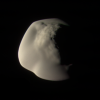
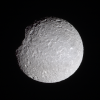
Mimas is the anti-Enceladus. At 397 kilometers in diameter it is not all that much smaller than 512-kilometer Enceladus, the next biggish moon out. But its ancient, cratered surface tells you that nothing particularly exciting has happened there over the past few billion years, unlike on geyser-rich Enceladus. When people post a picture of Mimas, they usually post one that includes a view of its gigantic crater, Herschel, and make a comment about how much it looks like the Death Star. So, to be different, I'm posting a view of Mimas that almost doesn't include Herschel. The crater is there -- it's taking a bite out of the terminator at left.

This photo is actually in color, believe it or not; Mimas is very, very gray. Mimas is also not a sphere -- it's squashed around the middle, a result of its relatively fast rotation coupled with its relatively low gravity and its relatively close position to Saturn, which excites a pretty big tidal bulge. All in all, Mimas' surface tells you a great deal about the forces active within the Saturn system that act from the outside to control the shapes and surfaces of Saturn's moons.
Mimas sits on the boundary between round moons and lumpy "rocks." It has just enough self-gravity to be round -- or mostly so; the impactor that made Herschel came along relatively late in Mimas' formation, when the moon was pretty cold. The next smaller moons at Saturn are Hyperion, Janus, and Phoebe, all of which are very lumpy indeed. I think it's interesting how the roundness of these icy worlds depends in part on the timing of large impacts. Large impacts were undoubtedly part of the story of formation of these things, but early in their history they would have had enough primordial heat for their interiors to be relatively squishy (even if not liquid). As they aged, cooled, and hardened, impact scars were better and better preserved. I wonder if Mimas is rounder than Hyperion because it's closer to Saturn, experienced more tidal heating, and had some earlier lumpiness erased? Each one of these moons has its own, unique story to tell.
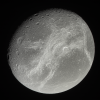
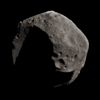
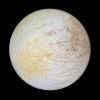
Each day in December I'm posting a new global shot of a solar system body, processed by an amateur. Go to the blog homepage to open the most recent door in the planetary advent calendar!
You Power the Next Great Discovery!
Fund future scientific research that advances space science and exploration with your gift today.
Donate