

 Explore Worlds
 Find Life
 Defend Earth

Planetary Society Advent Calendar for December 11: Io

Written by
Emily Lakdawalla
December 11, 2009
This is a special post for all of my readers who are lighting the first candle on their menorot this evening. I give you the solar system's candelabra, the innermost of Jupiter's Galilean moons, Io. Tugged among the gravitational pulls of Jupiter, Europa, and Ganymede, Io is continuously flexed and squeezed, generating so much heat through tidal friction that it is in a constant state of eruption. Its volcanic activity was first discovered on March 9, 1979, in a Voyager 1 image taken for optical navigation purposes. Since then, every spacecraft to visit Jupiter has observed further volcanic activity at Io. Between spacecraft visits, Earth-based instruments have detected the thermal emission from its lava flows. One volcano in particular, Prometheus, whose eruption plume is visible on the right-hand side of this image, has (as far as anyone knows) been erupting nonstop, around the clock and around the calendar, lighting the darkness at Jupiter for more than thirty years straight.

I selected this particular image because it was one of many from the Galileo mission that was never press-released (although I am sure it has been examined closely by scientists). Although Galileo returned to Earth many fewer images than it might have, had its high-gain antenna worked properly, there are still plenty of gems in its archives waiting to be explored. Io fan Jason Perry is in the middle of an ongoing project to process and post every Galileo image of Io, including the one I posted above, from orbit G8; now somebody needs to do the same for the Galileo images of Jupiter's other moons!
Happy Hannukah, everyone!
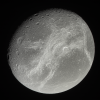
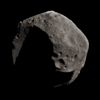
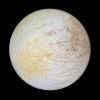
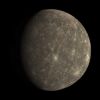
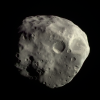
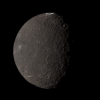
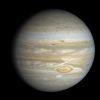
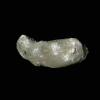
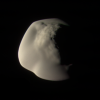
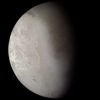
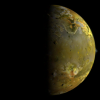
Each day in December I'm posting a new global shot of a solar system body, processed by an amateur. Go to the blog homepage to open the most recent door in the planetary advent calendar!
You Power the Next Great Discovery!
Fund future scientific research that advances space science and exploration with your gift today.
Donate