

 Explore Worlds
 Find Life
 Defend Earth


Planetary Society Advent Calendar for December 2: Mathilde

Written by
Emily Lakdawalla
December 2, 2009
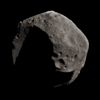
253 Mathilde is the largest asteroid that has ever been visited by a spacecraft (as is obvious when you look at this montage of all asteroids visited by spacecraft, a version of which you can buy from our new store at Cafe Press). It's held that distinction for more than twelve years, but next year it'll be upstaged by the considerably larger 21 Lutetia, which Rosetta will fly by on July 10.
In the years since NEAR visited Mathilde, there haven't been too many publications on it, and they (or at least their abstracts) seem to indicate puzzlement about its internal structure. Its density is barely higher than that of water at 1.3 grams per cubic centimeter (water is 1 g/cc) so it has to be highly porous -- a rubble pile -- but the images that NEAR took indicate that at least some parts of the asteroid are locally fairly cohesive. I mean no disrespect to asteroid scientists when I say that I don't think we understand the internal structure of these little worlds very well at all. Partially because of that, I am dying to witness (virtually anyway) the adventures of the first astronauts to explore an asteroid up close, an event that I hope will happen in my lifetime.

Past advent calendar entries:
Each day in December I'm posting a new global shot of a solar system body, processed by an amateur. Go to the blog homepage to open the most recent door in the planetary advent calendar!
You Power the Next Great Discovery!
Fund future scientific research that advances space science and exploration with your gift today.
Donate