

 Explore Worlds
 Find Life
 Defend Earth


Cassini goodies: Telesto, Janus, Prometheus, Pandora, F ring

Written by
Emily Lakdawalla
September 1, 2009
As I mentioned yesterday, the Cassini raw images website has been full of goodies lately. Here's a sample.
(First, a quick update on the Station fire: Mount Wilson is still unscathed, and firefighters predict today will be a better day. Concern is abating.)
My favorite recent set of images was targeted at Janus. Take a look at this animation and see if you can figure out what's going on before you read any further:
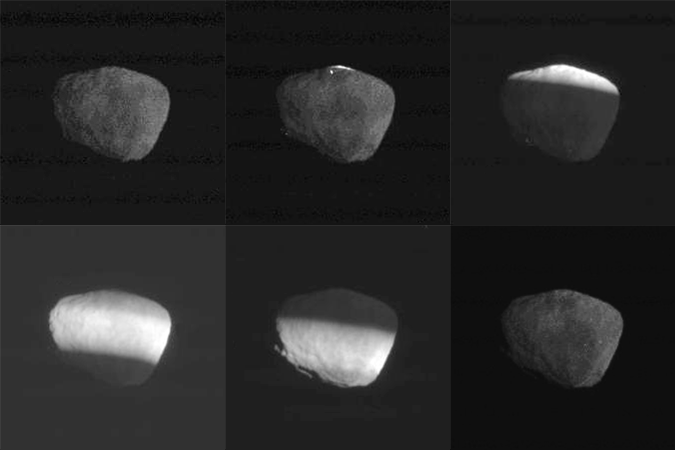 Janus is the 10th largest moon of Saturn, 196 x 192 x 150 kilometers in diameter and orbits along with Epimetheus between the F and G rings.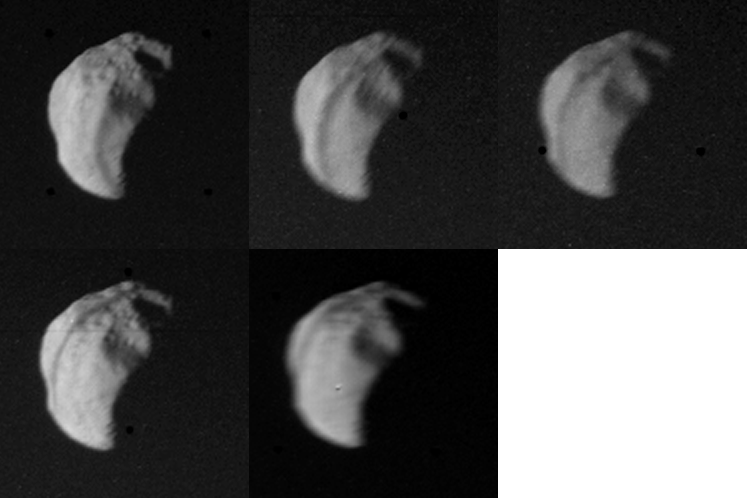
NASA / JPL / animation by Emily Lakdawalla
Epimetheus from Voyager 1
On November 12, 1980, Voyager 1 captured a series of images of Epimetheus through different color filters. During the sequence, the shadow of the F ring crossed the moon.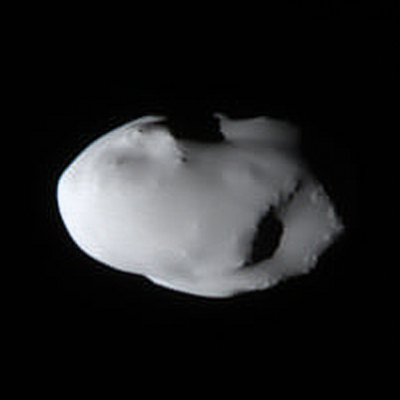
NASA / JPL / SSI / color composite by Gordan Ugarkovic
Telesto
Cassini captured this view of the leading hemisphere of Telesto on August 27, 2009. Telesto is a small moon, 34 x 28 x 36 kilometers in diameter, that occupies a Lagrange point behind Tethys in its orbit around Saturn. This is an approximately natural color view composed of raw images.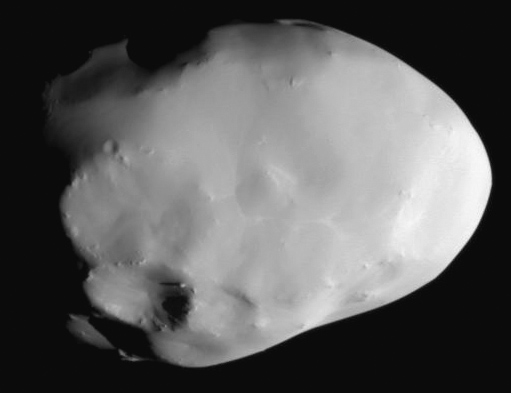
NASA / JPL / Space Science Institute
Saturn's moon Telesto
This raw image was captured by Cassini during its closest planned encounter with Telesto, on October 11, 2005.
NASA / JPL / SSI / animation by Mike Malaska
Prometheus, Pandora, and the F ring
Cassini captured the images that compose this animation on August 20, 2009. At present, Prometheus (the inner shepherd of the F ring) and the F ring collide with every orbit of Prometheus around Saturn. Prometheus dips into the F ring, causing a gore and pulling out a streamer of material. On the next orbit, Prometheus dips into the F ring ahead of its previous position. The result is a series of gores that slowly get sheared out as a result of the differential rates that the ring particles orbit Saturn (objects closer to Saturn complete one orbit in a shorter period of time than objects farther from Saturn). Pandora, the outer shepherd of the F ring, is also visible in this animation. The moons are lit from below by the Sun and from above by Saturnshine.You Power the Next Great Discovery!
Fund future scientific research that advances space science and exploration with your gift today.
Donate