

 Explore Worlds
 Find Life
 Defend Earth

Update to my S/2008 S1 post: Cassini can fly past it!

Written by
Emily Lakdawalla
March 4, 2009
UPDATE: This new moon is now named Aegaeon.
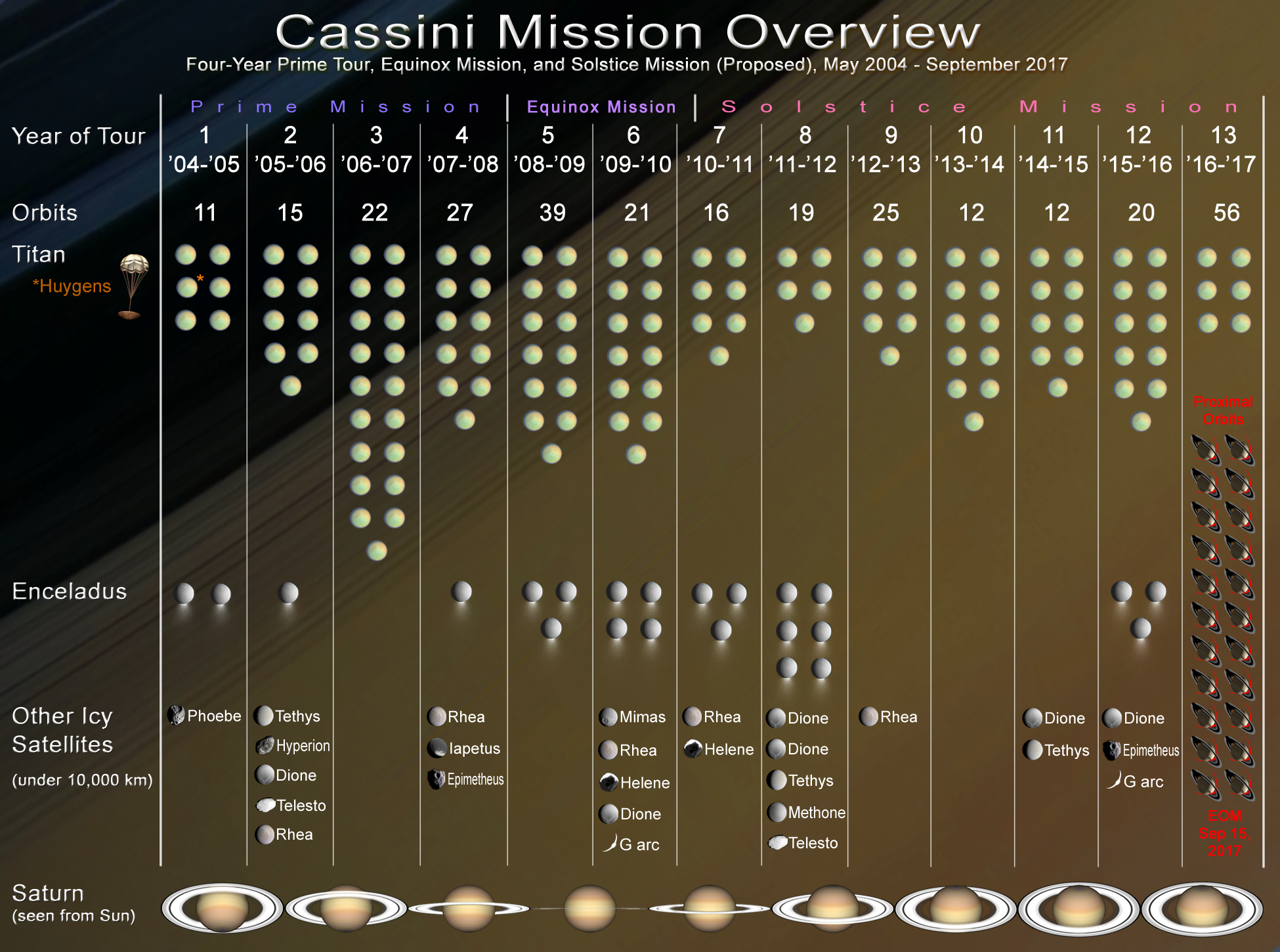
So it turns out I was totally wrong yesterday when I claimed that Cassini wouldn't be allowed to get close enough to the G ring to get a decent image of the newly discovered tiny moonlet S/2008 S1. And actually the clue was sitting right in front of me in the form of that "Cassini Mission Overview" slide I posted last week. Check out the "other icy satellites" row for year 6 and year 12 of the tour:
NASA / JPL
Overview of Cassini's mission to Saturn
A summary of the completed and planned close flybys of Saturn's moons through Cassini's prime, extended ("Equinox"), and proposed extended-extended ("Solstice") missions.Yes, the G ring is "dusty and extended", but the core of the ring, where the arc and this parent body lives, is only about 500 km wide radially and 500 km thick vertically. (The full ring is more like 11,000 km radial extent by 1,000 km vertical extent.)So we could get quite close to it. Flying over or under it in an orbit with a small inclination would allow us to image S/2008 S1 quite safely in theory. And don't forget, both Pioneer 11 and Voyager 2 flew directly through the extended G ring (Voyager 2 through the "core"). Cassini has clipped the edges of the extended G ring region a number of times already, and will several more times in the coming years (it is, after all, one of the objects of interest to scientists). But you are correct in that we very specifically avoid flying through or very near to the core region, especially near this bright arc and parent body.
You Power the Next Great Discovery!
Fund future scientific research that advances space science and exploration with your gift today.
Donate