

 Explore Worlds
 Find Life
 Defend Earth


A great view of the Phoenix lander

Written by
Emily Lakdawalla
July 16, 2008
Last week the HiRISE team released a new view of the Phoenix lander on Mars, one taken from a particularly good geometry. There really aren't words to describe what a revolution HiRISE images mean for mapping landing sites. I'll let the photos speak for themselves. The colors are a result of my fiddling and are not necessarily representative of what the landscape would look like to human color vision; in any case HiRISE sees in a range of wavelengths pushed a bit into the infrared from what human eyes see.

NASA / JPL / U. Arizona
Phoenix lander, sol 21
The Mars Reconnaissance Orbiter HiRISE camera captured this view of the Phoenix lander sitting on Mars on June 16, sol 21 of the lander's mission. Three components are visible: the backshell and parachute at the top of the image; the blackened heatshield (and bounce mark) at center left; and the lander itself at bottom right. Some of the amazing details visible in this image are the parachute's shroud lines, the stripes on the parachute, and the pattern of color on the lander's fan-shaped solar panels, with more reflective metal in the center and more dark blue solar cells toward the edge.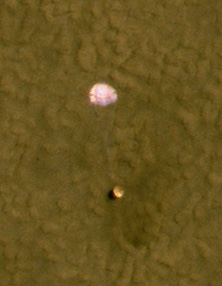
The Phoenix backshell and parachute

The Phoenix lander
Protect Our Shared Future
You help us defend humanity and prevent asteroid impacts. Donate now to become a Planetary Defender!
Donate