

 Explore Worlds
 Find Life
 Defend Earth


Earthrise and Earthset from Kaguya

Written by
Emily Lakdawalla
November 13, 2007
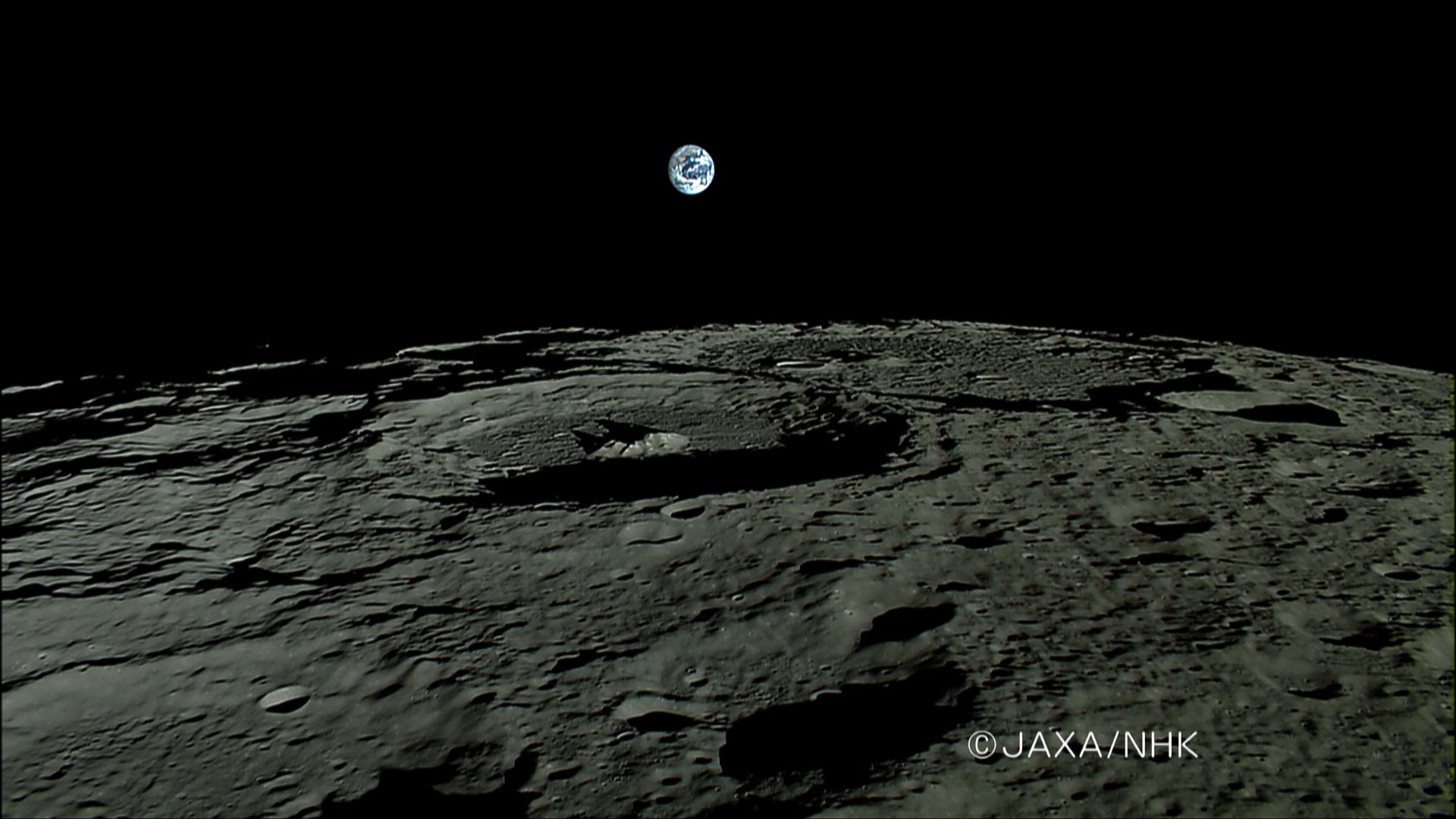
Kaguya has delivered on its promise to send high-definition movies from the Moon, and it was worth the wait. This morning JAXA and the Japan Broadcasting Corporation (NHK) released several still images and a movie showing an Earthrise and an Earthset over the lunar limb captured by Kaguya on November 7. The images bring to mind the Apollo 8 and 11 Earthrise photos, but, unlike the Apollo images, the Kaguya ones feature a nearly fully lit Earth. Not to mention the fact that the Kaguya images are parts of actual movies! As someone who was too young to witness the Apollo missions and their live TV coverage, these are my first movies from the Moon.
JAXA / NHK
Earthrise over the Moon
JAXA / NHK / animation by Emily Lakdawalla
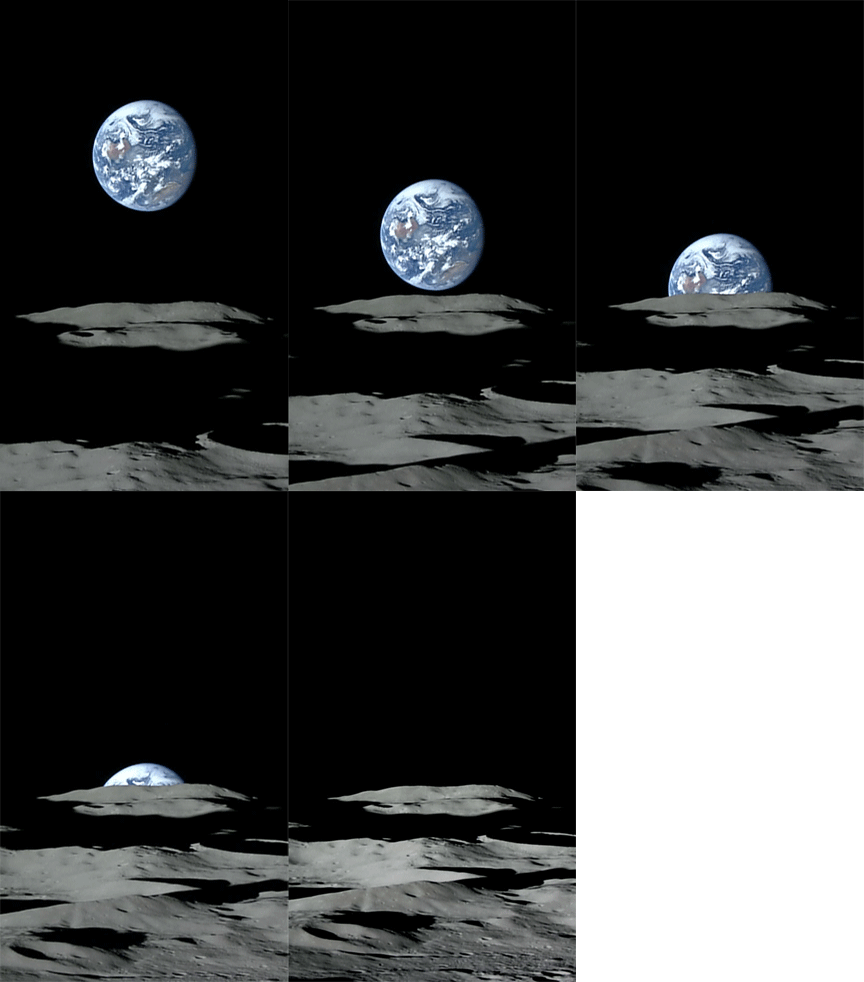
Earthset over the lunar south pole
The individual frames were taken roughly 20 seconds apart.If these movies are like the ones previously released by the Kaguya mission, they were shot with a low frame rate so that time in the movie is sped up by a factor of eight. Even at that, the movie is nearly nine minutes long, showing first the Earthrise and then the Earthset. In the Earthrise movie, all is still, with the Moon's surface barely moving beneath the spacecraft, for almost a minute and a half, until a tiny bright arc appears just above the lunar limb and slowly, slowly rises. The Earthset video starts at about 4:20. This one is more dramatic, as Kaguya is looking across a twilit, rugged south pole with its telephoto camera. Earth almost immediately appears at the top of the frame, much larger than in the Earthrise video. As I watched it approach the horizon, my brain expected Earth to pass in front of the two lunar peaks on the horizon -- my art teacher in high school taught me that the brain sees lighter tones as being closer to the eye than darker tones -- but Earth kisses the horizon and then passes behind it. As Earth's disk disappears, the exposure suddenly adjusts on the camera. Earth, with its snow-white clouds, is more reflective than the Moon; with the exposure set for Earth, the Moon appeared dark. With Earth out of the picture, the auto-exposure adjusts to whiten the lunar mountain peaks, revealing streaks and colors on the lunar surface.
Kaguya is getting one of these Earthrises and Earthsets on every single orbit of the Moon. I don't know how much video it's shooting. I have a fantasy of a giant plasma screen somewhere showing a live HD feed from Kaguya's rear window, with the cratered surface slowly slipping backward. Every once in a while, almost by chance, a bright disk appears in the blackness of space -- our home -- and I suddenly get a feeling of vertigo, realizing that I'm watching a spacecraft watch me.
Cool.
You Power the Next Great Discovery!
Fund future scientific research that advances space science and exploration with your gift today.
Donate