

 Explore Worlds
 Find Life
 Defend Earth


Funny little Atlas

Written by
Emily Lakdawalla
June 13, 2007
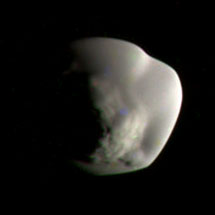
Here's an image I put together from three raw images taken through red, green, and blue filters.
NASA / JPL / SSI / Color composite by Emily Lakdawalla
Atlas
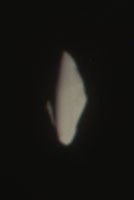
Cassini flew to within 40,000 kilometers of Atlas on June 12, 2007 to capture this view of the unusually-shaped moon. The view is toward Atlas' south pole.I checked through the data that has already been released to the Planetary Data System by the imaging team, and found only one other set of red, green, and blue images of Atlas that were taken from close enough to show good detail on the surface. To my surprise, as far as I can tell, this set of images has not been turned in to a formal image release by the imaging team, so I did my best to put them together. The image was taken on June 8, 2005 from a distance of approximately 162,000 kilometers.
NASA / JPL / SSI / Color composite by Emily Lakdawalla
Atlas
Three images through red, green, and blue filters have been combined to create this color view, which is also enlarged by a factor of two. The view of Atlas shows a saucer shape, 46 by 20 kilometers in size. Atlas' equator appears to have swept up fine ring dust, obscuring any impact craters and bulging its equator. Image data is from the official Cassini data release on the Planetary Data System.You Power the Next Great Discovery!
Fund future scientific research that advances space science and exploration with your gift today.
Donate